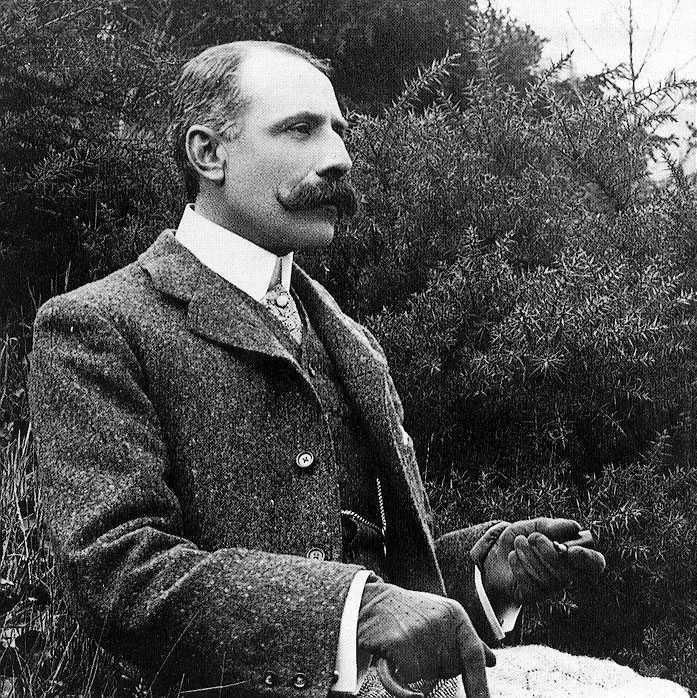
Sir Edward William Elgar
- Dates
- 2 Jun 1857 - 23 Feb 1934
- Works
- 19
- Sheet music
- 19
Biography
Sir Edward William Elgar, 1st Baronet, OM, GCVO (2 June 1857 – 23 February 1934) was an English composer. He is known for such works as the Enigma Variations, the Pomp and Circumstance Marches, The Dream of Gerontius, concertos for violin and cello, and two symphonies. He also composed oratorios, chamber music and songs. He was appointed Master of the King's Musick in 1924.
Biography
Early years
Edward Elgar was born in the small village of Lower Broadheath outside Worcester, England to William Elgar, a music dealer, and his wife Anne (née Greening). Elgar was the fourth of their seven children: Henry John (known as Harry, 15 October 1848 – 5 May 1864), Lucy Ann (Loo, born 29 May 1852), Susannah Mary (Pollie, 28 December 1854), Edward William (Ted, 2 June 1857), Frederick Joseph (Jo, 28 August 1859 – 1866), Francis Thomas (Frank, 1 October 1861), and Helen Agnes (Dott or Dot, 1 January 1864). His mother, Anne, had converted to Roman Catholicism shortly before Edward's birth, so Edward was baptised and brought up as a Roman Catholic.
Elgar was an early riser, and would often turn to reading Voltaire, Drayton historical classics, Longfellow and other works encouraged by his mother. By the age of eight, he was taking piano and violin lessons, and would often listen to his father playing the organ at St. George's church, and soon also took it up. His prime interest, however, was the violin, and his first written music was for that instrument.
Surrounded by sheet music, instruments, and music textbooks in his father's shop in Worcester's High Street, the young Elgar became self-taught in music theory. On warm summer days, he would take scores into the countryside to study them (he was a passionate and adventurous early cyclist from the age of 5). Thus there began for him a strong association between music and nature. As he was later to say, "There is music in the air, music all around us, the world is full of it and you simply take as much as you require."
At the age of 15, Elgar had hoped to go to Leipzig, Germany to study music, but lacking the funds he instead left school and began working for a local solicitor. Around this time he made his first public appearances as a violinist and organist. After a few months, he left the solicitor and embarked on a musical career, giving piano and violin lessons, and working occasionally in his father's shop. Elgar was an active member of the Worcester Glee Club, along with his father, and he accompanied singers, played violin, composed and arranged works, and even conducted for the first time. At 22 he took up the post of bandmaster at the Worcester and County Lunatic Asylum in Powick, three miles south-west of Worcester, a progressive institution which believed in the recuperative powers of music. He composed here too; some of the pieces for the asylum orchestra (music in dance forms) were rediscovered and performed locally in 1996.
In many ways, his years as a young Worcestershire violinist were his happiest. He played in the first violins at the Worcester and Birmingham Festivals, and one great experience was to play Dvořák's Symphony No. 6 and Stabat Mater under the composer's baton. As part of a wind quintet and for his musical friends, he arranged dozens of pieces by Mozart, Beethoven, Haydn, and other masters, honing his arranging and compositional skills, and applying them to his earliest pieces. Although somewhat solitary and introspective by nature, Elgar thrived in Worcester's musical circles.
In his first trips abroad in 1880–82, Elgar visited Paris and Leipzig, attended concerts by first rate orchestras, and was exposed to the music of Richard Wagner, an immensely popular musician of the time. Returning to his more provincial milieu increased his desire for a wider fame. He often went to London in an attempt to get his works published, but this period in his life found him frequently despondent and low on money. He wrote to a friend in April 1884, "My prospects are about as hopeless as ever... I am not wanting in energy I think, so sometimes I conclude that 'tis want of ability...I have no money--not a cent."
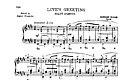
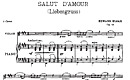
At 29, through his teaching, he met Caroline Alice Roberts, daughter of the late Major-General Sir Henry Roberts and a published author of verse and prose fiction. Eight years older than Elgar, Alice became his wife three years later, against the wishes of her family. They were married on 8 May 1889, at Brompton Oratory. Alice's faith in him and her courage in marrying 'beneath her class' were strongly supportive to his career. She dealt with his mood swings and was a generous musical critic. She was also his business manager and social secretary. She did her best to gain him the attention of influential society, though with limited success. In time he would learn to accept the honours given him, realizing that they mattered more to her and her social class. She also gave up some of her personal aspirations to further his career. In her diary she later admitted, "The care of a genius is enough of a life work for any woman." As an engagement present, Elgar presented her with the short violin and piano piece Salut d'Amour. With Alice's encouragement, the Elgars moved to London to be closer to the centre of British musical life, and Edward started composing in earnest. The stay was unsuccessful, however, and they were obliged to return to Great Malvern, where Edward could earn a living teaching and conducting local musical ensembles. Though disappointed at the London episode, the return to the country proved better for Elgar's health and as a base of musical inspiration, bringing him closer to nature and to his friends.
Their only child, Carice Irene, was born at their Avonmore Road home in Fulham on 14 August 1890. She was called by the name revealed in Elgar's dedication of Salut d'Amour: a contraction of her mother's names Caroline and Alice.
Growing reputation
During the 1890s Elgar gradually built up a reputation as a composer, chiefly of works for the great choral festivals of the English Midlands. The Black Knight and King Olaf (1896), both inspired by Longfellow, The Light of Life and Caractacus were all modestly successful and he obtained a long-standing publisher in Novello and Company. He also generously recommended the young composer Samuel Coleridge-Taylor to the Three Choirs Festival for a concert piece, which helped establish the younger man's career. Elgar was catching the eyes of the prominent critics, although their reviews were still lukewarm, and he was in demand as a festival composer, but he was just getting by financially and not feeling appreciated the way he wanted to be. In 1898, he continued to be "very sick at heart over music" and hoped to find a way to succeed with a larger work. His friend August Jaeger tried to lift his spirits, "A day's attack of the blues...will not drive away your desire, your necessity, which is to exercise those creative faculties which a kind providence has given you. Your time of universal recognition will come."
In 1899, that prediction suddenly came true. At the age of 42, Elgar's produced his first major orchestral work, the Enigma Variations, which was premiered in London under the baton of the eminent German conductor Hans Richter. In Elgar's own words, "I have sketched a set of Variations on an original theme. The Variations have amused me because I've labelled them with the nicknames of my particular friends... that is to say I've written the variations each one to represent the mood of the 'party' (the person)... and have written what I think they would have written--if they were asses enough to compose". Elgar dedicated the work "To my friends pictured within".
The large-scale work was received with general acclaim, heralded for its originality, charm, and fine craftsmanship, and it established Elgar as the pre-eminent British composer of his generation. It is formally titled Variations on an Original Theme; the word "Enigma" appears over the first six measures of music, which led to the familiar version of the title. The enigma is that, although there are fourteen variations on the "original theme", the 'enigma' theme, which Elgar said 'runs through and over the whole set' is never heard. Many later commentators have observed that although Elgar is today regarded as a characteristically English composer, his orchestral music and this work in particular share much with the Central European tradition typified at the time by the work of Richard Strauss. Indeed, the Enigma Variations were well-received in Germany, and persist to this day as a worldwide concert favourite.
The following year saw the production at the Birmingham Triennial Music Festival of his choral setting of Cardinal Newman's poem The Dream of Gerontius. Despite a disastrous first performance due to poorly prepared performers, the German premiere was much better received and the work was established within a few years as one of Elgar's greatest. It is now regarded as one of the finest examples of English choral music from any era.
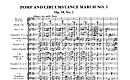
Elgar is probably best known for the five Pomp and Circumstance Marches, composed between 1901 and 1930. Shortly after he composed the first march, Elgar set the trio melody to words by A. C. Benson in his Coronation Ode to mark the coronation of King Edward VII. The suggestion had already been made (allegedly by the future King himself) that words should be fitted to the broad tune which formed the trio section of this march. Against the advice of his friends, Elgar suggested that Benson furnish further words to allow him to include it in the new work. The result was Land of Hope and Glory, which formed the finale of the Ode and was also issued (with slightly different words) as a separate song. The work was immensely popular and is now considered an unofficial national anthem. At last, he had made the leap from accomplished back-country musician to England's foremost composer. It also gained Elgar the highest recognition he could have dreamed of—honorary degrees, a knighthood, special royal audiences, and a triumphal three-day festival of his music at Covent Garden attended by the King and Queen.
In 1904 Elgar and his family moved to Plas Gwyn, a large house on the outskirts of Hereford, overlooking the River Wye, and they lived there until 1911.
Between 1902 and 1914 Elgar enjoyed phenomenal success, made four visits to the USA including one conducting tour, and earned considerable fees from the performance of his music. Between 1905 and 1908 Elgar held the post of Peyton Professor of Music at the University of Birmingham (he was succeeded by his friend Granville Bantock). His lectures there caused controversy owing to remarks he made about other English composers and English music in general; he was quoted as saying "English music is white - it evades everything". The University of Birmingham's Special Collections contain an archive of letters written by Elgar. His new life as a celebrity was a mixed blessing as it often provoked ill-health from his high-strung nature and interrupted his privacy. He complained to Alfred Jaeger in 1903, "My life is one continual giving up of little things which I love."
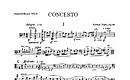
Elgar's Symphony No. 1 (1908) was given one hundred performances in its first year. The Violin Concerto in B minor (1910) was commissioned by the world-renowned violinist Fritz Kreisler and was a resounding success, premiered by Kreisler with the Philharmonic Society of London, the composer conducting. That year, he formed a long-lasting friendship with the violinist W, H. "Billy" Reed, the leader of the London Symphony Orchestra. Reed assisted Elgar in the writing of the Violin Concerto, and also helped him play through the sketches for the Third Symphony in the year before the composer's death. Reed's biography Elgar As I Knew Him was published in 1936, and records many intimate details of Elgar's methods of composition.
In 1911, the year of the completion of his Symphony No. 2, he had the Order of Merit bestowed upon him. In 1912 he moved back to London, again to be closer to musical society but to the detriment of his love of the countryside and to his general mood.
Elgar's musical legacy is primarily orchestral and choral, but he did write for soloists and smaller instrumental groups. His one work for brass band, the Severn Suite (later arranged by the composer for orchestra), remains an important part of the brass band repertoire. This work was dedicated to his friend George Bernard Shaw. It is occasionally performed in its arrangement by Sir Ivor Atkins for organ as the composer's second Organ Sonata; Elgar's first, much earlier (1895) Organ Sonata was written specifically for the instrument in a highly orchestral style, and remains a cornerstone of the English Romantic organ repertoire.
Later years
During World War I his music began to fall out of fashion. The war was overturning his world and his time. He himself grew to hate his 'Pomp and Circumstance' March No.1 with its popular tune (identified as 'Land of Hope and Glory' when the words were later added), which he felt had been made into a jingoistic song, not in keeping with the tragic loss of life in the war. This was captured in the film Elgar by Ken Russell. After the death of his wife in 1920, loneliness and declining interest in his art fostered little in the way of new works of importance. Shortly before her death he composed the elegiac Cello Concerto, often described as his last masterpiece. This was one of a late cluster of works composed while he lived between 1917 and 1921 at 'Brinkwells', a house near Fittleworth in Sussex which he had rented from the painter Rex Vicat Cole.
Elgar lived in the village of Kempsey, Worcestershire from 1923 to 1927. It was during this time, a few weeks before the performance of his Empire March and eight songs Pageant of Empire for the 1924 British Empire Exhibition, that he was made Master of the King's Musick.
He was the first composer to make extensive recordings of his own compositions. The Gramophone Company recorded much of his music acoustically from 1914 onwards and then began a series of electrical recordings in 1926 that continued until 1933, including his Enigma Variations, Falstaff, the first and second symphonies, his cello and violin concertos, all of the Pomp and Circumstance marches, and other orchestral works. Part of a 1927 rehearsal of the second symphony with the London Symphony Orchestra was also recorded and later issued.
In November 1931, Elgar was filmed by Pathé for a newsreel depicting a recording session of Pomp and Circumstance March No. 1 at the opening of the famous Abbey Road Studios in London. It is believed to be the only surviving sound film of Elgar, who makes a brief remark before conducting the London Symphony Orchestra, asking the musicians to "play this tune as though you've never heard it before." Silent films of the composer have also survived.
In the 1932 recording of the Violin Concerto, the aging composer worked with the American violinist Yehudi Menuhin, who was then only 16 years old; they worked well together and Menuhin warmly recalled his association with the composer years later, when he performed the concerto with the San Francisco Symphony. Menuhin later conducted an award-winning recording of Elgar's Cello Concerto with the cellist Julian Lloyd Webber and much of the major orchestral music.
Elgar's recordings usually featured such orchestras as the London Symphony Orchestra, the Royal Albert Hall Orchestra (which reverted in 1928 to its earlier name, New Symphony Orchestra) and, in 1933, the newly founded London Philharmonic Orchestra. Elgar's recordings were released on 78-rpm discs by both HMV and RCA Victor. In later years, EMI reissued the recordings on LP and CD.
In his later years, Elgar befriended young conductors such as Adrian Boult and Malcolm Sargent who championed his music when it was out of fashion.
At the end of his life Elgar began work on an opera, The Spanish Lady, and accepted a commission from the BBC to compose a Third Symphony. His final illness prevented their completion. Some time later, in cooperation with the BBC and Elgar's daughter, Percy Young produced a version of the Spanish Lady which was issued on CD.
He died from inoperable cancer (discovered during an operation in September 1933) on 23 February 1934 and was buried, at St. Wulstan's Church in Little Malvern, next to his wife Alice. Within four months, two more great English composers — Gustav Holst and Frederick Delius — were also dead.
Legacy
The Elgar Society was formed in 1951.
The house in Lower Broadheath where Elgar was born is now the Elgar Birthplace Museum, devoted to his life and work.
The statue of him at the end of Worcester High Street stands facing the cathedral, only yards from where his father's shop once stood.
Another statue of the composer is at the top of Church Street in Malvern, overlooking the town and giving visitors an opportunity to stand next to the composer in the shadow of the Hills which he so often regarded.
In September 2005, a statue sculpted by Jemma Pearson was unveiled near Hereford Cathedral in honour of his many musical and other associations with that city. It features Elgar with his bicycle.
From 1999 until early 2007, new Bank of England twenty pound notes featured a portrait of Elgar: from then, a new series of notes featured a portrait of Adam Smith. The change generated controversy, particularly because 2007 was the 150th anniversary of Elgar's birth.
Elgar's sketches for his third symphony were "elaborated" in the 1990s by the composer Anthony Payne, who also subsequently produced a performing version of the sketches for a sixth Pomp and Circumstance march, premiered at the Proms in August 2006. In 2007, the Elgar Society commissioned Payne to complete the orchestration of the music for Elgar’s Crown of India Suite, Op. 66.
Elgar's sketches for a piano concerto dating from 1913 were elaborated by the composer Robert Walker and first performed in August 1997 by the pianist David Owen Norris. The realisation has since been extensively revised.
Elgar's music is associated with two well-known occasions in Britain's annual calendar: the Pomp and Circumstance March No. 1 is played at the Last Night of the Proms, while at the Remembrance Day ceremony at the Cenotaph in London, 'Nimrod' from his Enigma Variations is performed by massed bands.
The trio of Pomp and Circumstance March No. 1 is ubiquitously used in the United States for high school and university graduations, and is known as "The Graduation Song" there.
The hit track Clubbed To Death by Rob Dougan, featured on the soundtrack to the 1999 movie The Matrix, is partially based on the Enigma Variations.
Venetian Snares used samples from Elgar's Cello Concerto In E Minor, Op. 85 on the track Szamár Madár on his album Rossz Csillag Alatt Született.
Many streets in the UK are named after Elgar: there are eleven Elgar Avenues, including one in Malvern, Worcestershire, and another close to the house where Elgar lived, "Plas Gwyn" in Hereford. A street in North Springfield, Virginia and a major road in Box Hill, Melbourne are also named after him.
On film and television, Elgar has been portrayed by George McGrath (in Elgar) and Graham Leaman (in Penda's Fen).
Extra-musical interests
Elgar was an ardent Wolverhampton Wanderers fan and may have travelled to home games from Worcester on his bicycle. Elgar bought Wolverhampton-produced Royal Sunbeam bicycles for himself and his wife in 1903: he named his "Mr. Phoebus", and visited the Sunbeam Works in Upper Villiers Street for 'tuning'.
During the first rehearsal for the young Yehudi Menuhin's forthcoming recording of the Violin Concerto, the violinist had played Elgar only the first page when the composer announced that all was going to be well, and that he was going to leave Menuhin and go "off to the races" at Pitchcroft, Worcester's racecourse. Lord Menuhin would often tell press interviewers this story; he would describe it as one of his favourite memories of Elgar.
Elgar was a keen amateur chemist, practising the hobby from a laboratory erected in his back garden. The original manuscript of the prelude to The Kingdom is stained with chemicals.
Quotations
1924 - He was made Master of the King's Musick
1925 - He received the Gold Medal of the Royal Philharmonic Society
Between 1900 and 1931 Elgar received honorary degrees from the Universities of Cambridge, Durham, Leeds, Oxford, Yale (USA), Aberdeen, Western Pennsylvania (USA), Birmingham and London.
Foreign academies of which he was made a member were Regia Accademia di Santa Cecilia, Rome; Accademia del Reale Istituto Musicale, Florence; Académie des Beaux Arts, Paris; Institut de France; American Academy of Arts.
Titles
Orchestral
with piano accompaniment, unless otherwise noted
Nelly: Polka (1881) (viola added) La Blonde: Polka (1882) (no flute; trombone replaces euphonium) Helcia: Polka (1883) (no flute; viola added) Blumine: Polka (1884) (no piccolo; no euphonium)
All for piano unless otherwise indicated
Transcriptions and arrangements
The above text is available under the Creative Commons Attribution-ShareAlike License ( creativecommons.org/licenses/by-sa/3.0/ ). It uses material from the Wikipedia article "Edward Elgar" ( en.wikipedia.org/wiki/Edward_Elgar ).
Biography
Early years
Edward Elgar was born in the small village of Lower Broadheath outside Worcester, England to William Elgar, a music dealer, and his wife Anne (née Greening). Elgar was the fourth of their seven children: Henry John (known as Harry, 15 October 1848 – 5 May 1864), Lucy Ann (Loo, born 29 May 1852), Susannah Mary (Pollie, 28 December 1854), Edward William (Ted, 2 June 1857), Frederick Joseph (Jo, 28 August 1859 – 1866), Francis Thomas (Frank, 1 October 1861), and Helen Agnes (Dott or Dot, 1 January 1864). His mother, Anne, had converted to Roman Catholicism shortly before Edward's birth, so Edward was baptised and brought up as a Roman Catholic.
Elgar was an early riser, and would often turn to reading Voltaire, Drayton historical classics, Longfellow and other works encouraged by his mother. By the age of eight, he was taking piano and violin lessons, and would often listen to his father playing the organ at St. George's church, and soon also took it up. His prime interest, however, was the violin, and his first written music was for that instrument.
Surrounded by sheet music, instruments, and music textbooks in his father's shop in Worcester's High Street, the young Elgar became self-taught in music theory. On warm summer days, he would take scores into the countryside to study them (he was a passionate and adventurous early cyclist from the age of 5). Thus there began for him a strong association between music and nature. As he was later to say, "There is music in the air, music all around us, the world is full of it and you simply take as much as you require."
At the age of 15, Elgar had hoped to go to Leipzig, Germany to study music, but lacking the funds he instead left school and began working for a local solicitor. Around this time he made his first public appearances as a violinist and organist. After a few months, he left the solicitor and embarked on a musical career, giving piano and violin lessons, and working occasionally in his father's shop. Elgar was an active member of the Worcester Glee Club, along with his father, and he accompanied singers, played violin, composed and arranged works, and even conducted for the first time. At 22 he took up the post of bandmaster at the Worcester and County Lunatic Asylum in Powick, three miles south-west of Worcester, a progressive institution which believed in the recuperative powers of music. He composed here too; some of the pieces for the asylum orchestra (music in dance forms) were rediscovered and performed locally in 1996.
In many ways, his years as a young Worcestershire violinist were his happiest. He played in the first violins at the Worcester and Birmingham Festivals, and one great experience was to play Dvořák's Symphony No. 6 and Stabat Mater under the composer's baton. As part of a wind quintet and for his musical friends, he arranged dozens of pieces by Mozart, Beethoven, Haydn, and other masters, honing his arranging and compositional skills, and applying them to his earliest pieces. Although somewhat solitary and introspective by nature, Elgar thrived in Worcester's musical circles.
In his first trips abroad in 1880–82, Elgar visited Paris and Leipzig, attended concerts by first rate orchestras, and was exposed to the music of Richard Wagner, an immensely popular musician of the time. Returning to his more provincial milieu increased his desire for a wider fame. He often went to London in an attempt to get his works published, but this period in his life found him frequently despondent and low on money. He wrote to a friend in April 1884, "My prospects are about as hopeless as ever... I am not wanting in energy I think, so sometimes I conclude that 'tis want of ability...I have no money--not a cent."
At 29, through his teaching, he met Caroline Alice Roberts, daughter of the late Major-General Sir Henry Roberts and a published author of verse and prose fiction. Eight years older than Elgar, Alice became his wife three years later, against the wishes of her family. They were married on 8 May 1889, at Brompton Oratory. Alice's faith in him and her courage in marrying 'beneath her class' were strongly supportive to his career. She dealt with his mood swings and was a generous musical critic. She was also his business manager and social secretary. She did her best to gain him the attention of influential society, though with limited success. In time he would learn to accept the honours given him, realizing that they mattered more to her and her social class. She also gave up some of her personal aspirations to further his career. In her diary she later admitted, "The care of a genius is enough of a life work for any woman." As an engagement present, Elgar presented her with the short violin and piano piece Salut d'Amour. With Alice's encouragement, the Elgars moved to London to be closer to the centre of British musical life, and Edward started composing in earnest. The stay was unsuccessful, however, and they were obliged to return to Great Malvern, where Edward could earn a living teaching and conducting local musical ensembles. Though disappointed at the London episode, the return to the country proved better for Elgar's health and as a base of musical inspiration, bringing him closer to nature and to his friends.
Their only child, Carice Irene, was born at their Avonmore Road home in Fulham on 14 August 1890. She was called by the name revealed in Elgar's dedication of Salut d'Amour: a contraction of her mother's names Caroline and Alice.
Growing reputation
During the 1890s Elgar gradually built up a reputation as a composer, chiefly of works for the great choral festivals of the English Midlands. The Black Knight and King Olaf (1896), both inspired by Longfellow, The Light of Life and Caractacus were all modestly successful and he obtained a long-standing publisher in Novello and Company. He also generously recommended the young composer Samuel Coleridge-Taylor to the Three Choirs Festival for a concert piece, which helped establish the younger man's career. Elgar was catching the eyes of the prominent critics, although their reviews were still lukewarm, and he was in demand as a festival composer, but he was just getting by financially and not feeling appreciated the way he wanted to be. In 1898, he continued to be "very sick at heart over music" and hoped to find a way to succeed with a larger work. His friend August Jaeger tried to lift his spirits, "A day's attack of the blues...will not drive away your desire, your necessity, which is to exercise those creative faculties which a kind providence has given you. Your time of universal recognition will come."
In 1899, that prediction suddenly came true. At the age of 42, Elgar's produced his first major orchestral work, the Enigma Variations, which was premiered in London under the baton of the eminent German conductor Hans Richter. In Elgar's own words, "I have sketched a set of Variations on an original theme. The Variations have amused me because I've labelled them with the nicknames of my particular friends... that is to say I've written the variations each one to represent the mood of the 'party' (the person)... and have written what I think they would have written--if they were asses enough to compose". Elgar dedicated the work "To my friends pictured within".
The large-scale work was received with general acclaim, heralded for its originality, charm, and fine craftsmanship, and it established Elgar as the pre-eminent British composer of his generation. It is formally titled Variations on an Original Theme; the word "Enigma" appears over the first six measures of music, which led to the familiar version of the title. The enigma is that, although there are fourteen variations on the "original theme", the 'enigma' theme, which Elgar said 'runs through and over the whole set' is never heard. Many later commentators have observed that although Elgar is today regarded as a characteristically English composer, his orchestral music and this work in particular share much with the Central European tradition typified at the time by the work of Richard Strauss. Indeed, the Enigma Variations were well-received in Germany, and persist to this day as a worldwide concert favourite.
The following year saw the production at the Birmingham Triennial Music Festival of his choral setting of Cardinal Newman's poem The Dream of Gerontius. Despite a disastrous first performance due to poorly prepared performers, the German premiere was much better received and the work was established within a few years as one of Elgar's greatest. It is now regarded as one of the finest examples of English choral music from any era.
Elgar is probably best known for the five Pomp and Circumstance Marches, composed between 1901 and 1930. Shortly after he composed the first march, Elgar set the trio melody to words by A. C. Benson in his Coronation Ode to mark the coronation of King Edward VII. The suggestion had already been made (allegedly by the future King himself) that words should be fitted to the broad tune which formed the trio section of this march. Against the advice of his friends, Elgar suggested that Benson furnish further words to allow him to include it in the new work. The result was Land of Hope and Glory, which formed the finale of the Ode and was also issued (with slightly different words) as a separate song. The work was immensely popular and is now considered an unofficial national anthem. At last, he had made the leap from accomplished back-country musician to England's foremost composer. It also gained Elgar the highest recognition he could have dreamed of—honorary degrees, a knighthood, special royal audiences, and a triumphal three-day festival of his music at Covent Garden attended by the King and Queen.
In 1904 Elgar and his family moved to Plas Gwyn, a large house on the outskirts of Hereford, overlooking the River Wye, and they lived there until 1911.
Between 1902 and 1914 Elgar enjoyed phenomenal success, made four visits to the USA including one conducting tour, and earned considerable fees from the performance of his music. Between 1905 and 1908 Elgar held the post of Peyton Professor of Music at the University of Birmingham (he was succeeded by his friend Granville Bantock). His lectures there caused controversy owing to remarks he made about other English composers and English music in general; he was quoted as saying "English music is white - it evades everything". The University of Birmingham's Special Collections contain an archive of letters written by Elgar. His new life as a celebrity was a mixed blessing as it often provoked ill-health from his high-strung nature and interrupted his privacy. He complained to Alfred Jaeger in 1903, "My life is one continual giving up of little things which I love."
Elgar's Symphony No. 1 (1908) was given one hundred performances in its first year. The Violin Concerto in B minor (1910) was commissioned by the world-renowned violinist Fritz Kreisler and was a resounding success, premiered by Kreisler with the Philharmonic Society of London, the composer conducting. That year, he formed a long-lasting friendship with the violinist W, H. "Billy" Reed, the leader of the London Symphony Orchestra. Reed assisted Elgar in the writing of the Violin Concerto, and also helped him play through the sketches for the Third Symphony in the year before the composer's death. Reed's biography Elgar As I Knew Him was published in 1936, and records many intimate details of Elgar's methods of composition.
In 1911, the year of the completion of his Symphony No. 2, he had the Order of Merit bestowed upon him. In 1912 he moved back to London, again to be closer to musical society but to the detriment of his love of the countryside and to his general mood.
Elgar's musical legacy is primarily orchestral and choral, but he did write for soloists and smaller instrumental groups. His one work for brass band, the Severn Suite (later arranged by the composer for orchestra), remains an important part of the brass band repertoire. This work was dedicated to his friend George Bernard Shaw. It is occasionally performed in its arrangement by Sir Ivor Atkins for organ as the composer's second Organ Sonata; Elgar's first, much earlier (1895) Organ Sonata was written specifically for the instrument in a highly orchestral style, and remains a cornerstone of the English Romantic organ repertoire.
Later years
During World War I his music began to fall out of fashion. The war was overturning his world and his time. He himself grew to hate his 'Pomp and Circumstance' March No.1 with its popular tune (identified as 'Land of Hope and Glory' when the words were later added), which he felt had been made into a jingoistic song, not in keeping with the tragic loss of life in the war. This was captured in the film Elgar by Ken Russell. After the death of his wife in 1920, loneliness and declining interest in his art fostered little in the way of new works of importance. Shortly before her death he composed the elegiac Cello Concerto, often described as his last masterpiece. This was one of a late cluster of works composed while he lived between 1917 and 1921 at 'Brinkwells', a house near Fittleworth in Sussex which he had rented from the painter Rex Vicat Cole.
Elgar lived in the village of Kempsey, Worcestershire from 1923 to 1927. It was during this time, a few weeks before the performance of his Empire March and eight songs Pageant of Empire for the 1924 British Empire Exhibition, that he was made Master of the King's Musick.
He was the first composer to make extensive recordings of his own compositions. The Gramophone Company recorded much of his music acoustically from 1914 onwards and then began a series of electrical recordings in 1926 that continued until 1933, including his Enigma Variations, Falstaff, the first and second symphonies, his cello and violin concertos, all of the Pomp and Circumstance marches, and other orchestral works. Part of a 1927 rehearsal of the second symphony with the London Symphony Orchestra was also recorded and later issued.
In November 1931, Elgar was filmed by Pathé for a newsreel depicting a recording session of Pomp and Circumstance March No. 1 at the opening of the famous Abbey Road Studios in London. It is believed to be the only surviving sound film of Elgar, who makes a brief remark before conducting the London Symphony Orchestra, asking the musicians to "play this tune as though you've never heard it before." Silent films of the composer have also survived.
In the 1932 recording of the Violin Concerto, the aging composer worked with the American violinist Yehudi Menuhin, who was then only 16 years old; they worked well together and Menuhin warmly recalled his association with the composer years later, when he performed the concerto with the San Francisco Symphony. Menuhin later conducted an award-winning recording of Elgar's Cello Concerto with the cellist Julian Lloyd Webber and much of the major orchestral music.
Elgar's recordings usually featured such orchestras as the London Symphony Orchestra, the Royal Albert Hall Orchestra (which reverted in 1928 to its earlier name, New Symphony Orchestra) and, in 1933, the newly founded London Philharmonic Orchestra. Elgar's recordings were released on 78-rpm discs by both HMV and RCA Victor. In later years, EMI reissued the recordings on LP and CD.
In his later years, Elgar befriended young conductors such as Adrian Boult and Malcolm Sargent who championed his music when it was out of fashion.
At the end of his life Elgar began work on an opera, The Spanish Lady, and accepted a commission from the BBC to compose a Third Symphony. His final illness prevented their completion. Some time later, in cooperation with the BBC and Elgar's daughter, Percy Young produced a version of the Spanish Lady which was issued on CD.
He died from inoperable cancer (discovered during an operation in September 1933) on 23 February 1934 and was buried, at St. Wulstan's Church in Little Malvern, next to his wife Alice. Within four months, two more great English composers — Gustav Holst and Frederick Delius — were also dead.
Legacy
The Elgar Society was formed in 1951.
The house in Lower Broadheath where Elgar was born is now the Elgar Birthplace Museum, devoted to his life and work.
The statue of him at the end of Worcester High Street stands facing the cathedral, only yards from where his father's shop once stood.
Another statue of the composer is at the top of Church Street in Malvern, overlooking the town and giving visitors an opportunity to stand next to the composer in the shadow of the Hills which he so often regarded.
In September 2005, a statue sculpted by Jemma Pearson was unveiled near Hereford Cathedral in honour of his many musical and other associations with that city. It features Elgar with his bicycle.
From 1999 until early 2007, new Bank of England twenty pound notes featured a portrait of Elgar: from then, a new series of notes featured a portrait of Adam Smith. The change generated controversy, particularly because 2007 was the 150th anniversary of Elgar's birth.
Elgar's sketches for his third symphony were "elaborated" in the 1990s by the composer Anthony Payne, who also subsequently produced a performing version of the sketches for a sixth Pomp and Circumstance march, premiered at the Proms in August 2006. In 2007, the Elgar Society commissioned Payne to complete the orchestration of the music for Elgar’s Crown of India Suite, Op. 66.
Elgar's sketches for a piano concerto dating from 1913 were elaborated by the composer Robert Walker and first performed in August 1997 by the pianist David Owen Norris. The realisation has since been extensively revised.
Elgar's music is associated with two well-known occasions in Britain's annual calendar: the Pomp and Circumstance March No. 1 is played at the Last Night of the Proms, while at the Remembrance Day ceremony at the Cenotaph in London, 'Nimrod' from his Enigma Variations is performed by massed bands.
The trio of Pomp and Circumstance March No. 1 is ubiquitously used in the United States for high school and university graduations, and is known as "The Graduation Song" there.
The hit track Clubbed To Death by Rob Dougan, featured on the soundtrack to the 1999 movie The Matrix, is partially based on the Enigma Variations.
Venetian Snares used samples from Elgar's Cello Concerto In E Minor, Op. 85 on the track Szamár Madár on his album Rossz Csillag Alatt Született.
Many streets in the UK are named after Elgar: there are eleven Elgar Avenues, including one in Malvern, Worcestershire, and another close to the house where Elgar lived, "Plas Gwyn" in Hereford. A street in North Springfield, Virginia and a major road in Box Hill, Melbourne are also named after him.
On film and television, Elgar has been portrayed by George McGrath (in Elgar) and Graham Leaman (in Penda's Fen).
Extra-musical interests
Elgar was an ardent Wolverhampton Wanderers fan and may have travelled to home games from Worcester on his bicycle. Elgar bought Wolverhampton-produced Royal Sunbeam bicycles for himself and his wife in 1903: he named his "Mr. Phoebus", and visited the Sunbeam Works in Upper Villiers Street for 'tuning'.
During the first rehearsal for the young Yehudi Menuhin's forthcoming recording of the Violin Concerto, the violinist had played Elgar only the first page when the composer announced that all was going to be well, and that he was going to leave Menuhin and go "off to the races" at Pitchcroft, Worcester's racecourse. Lord Menuhin would often tell press interviewers this story; he would describe it as one of his favourite memories of Elgar.
Elgar was a keen amateur chemist, practising the hobby from a laboratory erected in his back garden. The original manuscript of the prelude to The Kingdom is stained with chemicals.
Quotations
- " wonderful in its heroic melancholy" - William Butler Yeats, on the incidental music for Grania and Diarmid.
- "The trees are singing my music", Elgar wrote. "Or have I sung theirs?"
- "This is the best of me; for the rest, I ate, and drank, and slept, loved and hated, like another. My life was as the vapour, and is not; but this I saw, and knew; this, if anything of mine, is worth your memory". - John Ruskin, quoted by Elgar on the manuscript score of The Dream of Gerontius.
- "Well, my boy, it's damned hard work" - Elgar to a young aspiring composer Alan Bush, on being asked what it was like to be a composer. (Recounted by Bush to members of the Workers' Music Association).
- Mr Edward Elgar (1857–1900)
- Dr Edward Elgar (1900–1904)
- Sir Edward Elgar (1904–1911)
- Sir Edward Elgar OM (1911–1928)
- Sir Edward Elgar OM KCVO (1928–1931)
- Sir Edward Elgar, 1st Baronet OM KCVO (1931–1933)
- Sir Edward Elgar, 1st Baronet OM GCVO (1933–1934)
Orchestral
- Three symphonies
- Sevillaña, Op. 7 (1884)
- Froissart, concert-overture, Op. 19 (1890)
- Serenade, for string orchestra, Op. 20 (revised version of Three Pieces for string orchestra, 1888–92)
- Sursum corda, for strings, brass and organ, Op. 11 (1894)
- Minuet, Op. 21 (1897 piano version, orchestrated in 1899)
- Three Bavarian Dances, Op. 27 (1897)
- Imperial March, Op. 32 (1897)
- Variations on an Original Theme (Enigma), Op. 36 (1899)
- Three Characteristic Pieces, Op. 10 (1899)
- Chanson de Nuit, Op. 15 No. 1 (1899, originally for violin and piano 1897)
- Sérénade Lyrique (1900)
- Cockaigne (In London Town), Concert-overture, Op. 40 (1900–01)
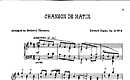
- Chanson de Matin, Op. 15 No. 2 (1901, originally for violin and piano 1899)
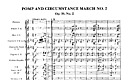
- Pomp and Circumstance, five marches, all Op. 39 (1901–1930)
- Dream Children (Enfants d'un Rêve), two pieces for small orchestra, Op. 43 (1902)
- In the South (Alassio), Concert-overture, Op.50 (1903–04)
- Introduction and Allegro for Strings (Quartet and Orchestra), Op. 47 (1904–05)
- The Wand of Youth, Suite No. 1, Op. 1a (1867–71, rev. 1907)
- The Wand of Youth, Suite No. 2, Op. 1b (1867–71, rev. 1908)
- Elegy, for string orchestra, Op. 58 (1909)
- Coronation March, Op. 65 (1911)
- The Crown of India, suite, Op. 66 (1911–12)
- Carissima (1913)
- Falstaff, symphonic study, Op. 68 (1913)
- Sospiri for string orchestra, harp and organ (or harmonium), Op. 70 (1914)
- Polonia, symphonic prelude, Op. 76 (1915)
- Rosemary (orchestration of the original work Douce Pensée for piano trio) (1915)
- Empire March for orchestra (1924)
- Suite from Arthur for chamber orchestra (from the incidental music to Laurence Binyon's Arthur, 1924)
- Civic Fanfare for orchestra excluding violins (1927)
- May-Song for small orchestra (orchestration of the original work for piano) (1928)
- Minuet from Beau Brummel (1928–29)
- Nursery Suite for orchestra (1931) "Dedicated by permission to their Royal Highnesses, the Duchess of York and the Princesses Elizabeth and Margaret Rose"
- Severn Suite, for orchestra, Op. 87 (1932) (originally composed for Brass Band in 1930)
- Mina for small orchestra (1933)
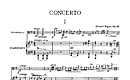
- Violin Concerto in B minor, Op. 61 (1909–10)
- Romance for bassoon and orchestra, Op. 62 (1909)
- Cello Concerto in E minor, Op. 85 (1918–19)
- Piano Concerto, Op. 90 (sketches, 1909–25, elaborated by Robert Walker)
- Grania and Diarmid, incidental music to a play by George Moore and W. B. Yeats, for contralto soloist and orchestra, Op. 42 (1901)
- The Crown of India, imperial masque for contralto and bass soloists, chorus and orchestra, Op. 66 (1911–12)
- Carillon, recitation with orchestra, Op. 75 (1914)
- Une voix dans le désert, recitation with soprano solo and orchestra, Op. 77 (1915)
- The Starlight Express, for baritone and soprano soloists and orchestra - music to a play by Violet Pearn based on the story "A Prisoner in Fairyland" by Algernon Blackwood, Op. 78 (1915–1916)
- The Fringes of the Fleet, words by Rudyard Kipling (1917)
- "Inside the Bar" (A Sailor's Song), for four baritones, words by Gilbert Parker (1917)
- Le drapeau belge (The Belgian Flag), recitation with orchestra, Op. 79 (1917)
- The Sanguine Fan, ballet (based on a fan designed by Charles Conder), Op. 81 (1917)
- Arthur, incidental music to a play by Laurence Binyon, for orchestra (1923)
- Beau Brummel, dramatic music to a play by Bertram P. Matthews, for orchestra (1928)
- The Black Knight, Symphony/Cantata for chorus and orchestra, Op. 25 (1889–92)
- The Light of Life (Lux Christi), oratorio for soprano, alto, tenor and bass soloists, chorus and orchestra, Op. 29 (1896)
- Scenes From The Saga Of King Olaf, cantata for soprano, tenor and bass soloists, chorus and orchestra, Op. 30 (1896)
- The Banner of St. George, ballad for chorus and orchestra, Op. 33 (1897)
- Caractacus, cantata for soprano, tenor, baritone and bass soloists, chorus and orchestra, Op. 35 (1897–98)
- Sea Pictures, song cycle for contralto or mezzo-soprano and orchestra, Op.37 (1897–99)
- The Dream of Gerontius, oratorio for mezzo-soprano, tenor and bass soloists, chorus and orchestra, Op. 38 (1899–1900)
- Coronation Ode for soprano, contralto, tenor and bass soloists, chorus and orchestra, Op. 44 (1902)
- The Apostles, oratorio for soprano, contralto, tenor and three bass soloists, chorus and orchestra, Op. 49 (1902–03)
- The Kingdom, oratorio for soprano, contralto, tenor and bass soloists, chorus and orchestra, Op. 51 (1901–06)
- O Hearken Thou, offertory for chorus and orchestra (Intende vocis orationis meae), Op. 64 (1911). For the Coronation of King George V
- The Music Makers, ode for contralto or mezzo-soprano soloist, chorus and orchestra, Op. 69 (1912)
- The Spirit of England, for soprano and contralto or tenor soloists, chorus and orchestra, Op. 80 (1915–17)
- The Smoking Cantata, for baritone soloist and orchestra. Written in 1919, this piece was probably never intended to be performed and was given the absurd opus number of 1001. Its duration is less than a minute.
- Queen Alexandra's Memorial Ode (So many true Princesses who have gone), for choir (SATB) and orchestra, words by John Masefield (1932)
with piano accompaniment, unless otherwise noted
- "The Language of Flowers", words by "Percival" (1872) (unpublished)
- "The Self Banished", song for soprano or tenor, Poem by Edmund Waller (1875) (unpublished)
- "A Soldier's Song", words by C. Flavell Hayward (1884) Republished in 1903 as "A War Song", Op. 5
- "Through the Long Days", words by John Hay, Op.16 No.2 (1885) Republished in Seven Lieder in 1907
- "Is she not passing fair?",Lay, written by Charles, Duke of Orleans (1391–1466) and translated by Louisa Stuart Costello (1886) but published in 1908
- "As I laye a-thynkynge", the last lines of Thomas Ingoldsby (1888)
- "The Wind at Dawn", poem by C. Alice Roberts (1888)
- "Queen Mary's Song", words by Alfred Tennyson (1889) Republished in Seven Lieder in 1907
- "Clapham Town End" (1890) An arrangement of a Yorkshire song (unpublished)
- "A Song of Autumn", words by Adam Lindsay Gordon (1892) Republished in Seven Lieder in 1907
- "Like to the Damask Rose", words by Simon Wastell (1892) Republished in Seven Lieder in 1907
- "The Poet's Life", words by Ellen Burroughs (1892) Republished in Seven Lieder in 1907
- "The Shepherd's Song", words by Barry Pain, Op.16 No.1 (1892) Republished in Seven Lieder in 1907
- "Rondel", words by Longfellow from a Rondel by Froissart, Op.16 No.3 (1894) Republished in Seven Lieder in 1907
- "Roundel: The little eyes that never knew Light", words from the Roundel "A Baby's Death" by Swinburne (1897) (unpublished)
- "Love alone will stay", words by C. Alice Elgar (1898)
- "Dry those fair, those crystal eyes", words by Henry King (1591–1669) Bishop of Chichester (1899)
- Vocal settings of Salut d'Amour, Op.12
- "After", words by Philip Bourke Marston, Op.31 No.1 (1900)
- "A Song of Flight", words by Christina Rossetti, Op.31 No.2 (1900)
- "The Pipes of Pan", words by Adrian Ross (1900)
- "Always and Everywhere", words by F. H. Fortey from the Polish of Krasinski (1901)
- "There are seven that pull the thread", for contralto and orchestra, from Grania and Diarmid, words by W. B. Yeats (1901)
- "Come, gentle night!", words by Clifton Bingham (1901)
- "In the Dawn", words by Arthur Christopher Benson, Op.41 No.1 (1901)
- "Speak, Music!", words by Arthur Christopher Benson. Op.41 No.2 (1901)
- "Land of Hope and Glory", words by Arthur Christopher Benson (1902)
- "Speak, my Heart!", words by Arthur Christopher Benson (1903)
- "A War Song", words by C. Flavell Hayward, Op.5 (1903)
- "In Moonlight", words by P. B. Shelley, adapted to the viola solo "Canto Popolare" from Elgar's concert-overture In the South (Alassio) (1904)
- Seven Lieder of Edward Elgar (1907)
- "Pleading", words by Arthur L. Salmon, Op.48 (1908)
- "A Child Asleep", words by Mrs. Browning (1910)
- "Oh, soft was the song", poem by Gilbert Parker, Op.59 No.3 (1910)
- "Was it some Golden Star?", poem by Gilbert Parker, Op.59 No.5 (1910)
- "Twilight", poem by Gilbert Parker, Op.59 No.6 (1910)
- "The Torch", words by 'Pietro d'Alba', Op.60 No.1 (1910)
- "The River", Folk-Song (Eastern Europe) paraphrased by 'Pietro d'Alba', Op,60 No.2 (1910)
- "The King's Way", words by C. Alice Elgar (1910)
- "Arabian Serenade", words by Margery Lawrence (1914)
- "The Chariots of the Lord", words by the Rev. John Brownlie D.D. (1914)
- "Follow the Colours", words by Capt. W. de Courcy Stretton, adapted from Marching Song for solo and optional male chorus and orchestra (1914)
- "Quand nos bourgeons se rouvriront" ("When the spring comes round again"), for soprano, from the recitation with orchestra "Une voix dans le désert", words by Émile Cammaerts (1915)
- "Fight for Right", words from a poem by William Morris (1916)
- The Starlight Express, words by Algernon Blackwood, Op.78 (1916)
- Pageant of Empire, poems by Alfred Noyes (1924). Nos. 5 and 7 also arranged for chorus SATB. All solo songs, except No. 8 for SATB. (some also with orchestral accompaniment)
- "It isnae me", words by Sally Holmes (1930)
- "XTC", words by the composer (1930)
- O Happy Eyes, part-song SATB unacc., words by C. Alice Elgar,, Op.18 No.1 (1890)
- Love, part-song SATB unacc., words by Arthur Macquarie, dedicated to C. Alice Elgar, Op.18 No.2 (1890)
- My Love Dwelt in a Northern Land, part-song SATB unacc., words by Andrew Lang, dedicated to Rev. J. Hampton (1890)
- Spanish Serenade (Stars of the Summer Night), part-song SATB acc. orchestra, words by H. W. Longfellow, Op.23 (1892) (also acc. 2 violins and piano)
- The Snow, part-song SSA acc. 2 violins and piano, words by C. Alice Elgar, dedicated to Mrs. E. B. Fitton, Op.26 No.1 (1894) (also with orchestral accompaniment, 1903, and various other combinations of voices SATB etc.)
- Fly, Singing Bird, part-song SSA acc. 2 violins and piano, words by C. Alice Elgar, dedicated to Mrs. E. B. Fitton, Op.26 No.2 (1894) (also with orchestral accompaniment, 1903)
- From the Bavarian Highlands, choral songs SATB and orchestra, words by C. Alice Elgar, Op. 27 (1895–96)
- Te Deum and Benedictus, for choir and organ, Op.34 (1897)
- Grete Malverne on a Rocke, Christmas carol SATB unacc. (1897)
- To Her Beneath Whose Steadfast Star, part-song SATB unacc., words by H. W. Longfellow, dedicated to Queen Victoria (1899)
- Ave verum corpus / Jesu, Word of God Incarnate, motet/anthem for choir and organ, Op.2 No.1, dedication "In mem. W. H." (1902, but written in 1887)
- Five Partsongs from the Greek Anthology, part-songs TTBB, Op.45 (1902)
- Weary Wind of the West, part-song SATB unacc., words by T. E. Brown, composed for Morecambe Festival (1903)
- Evening Scene, part-song SATB unacc., words by Coventry Patmore, In Memoriam R. G. H. Howson (1905)
- Ave Maria / Jesu, Lord of Life and Glory, motet/anthem for choir and organ, Op.2 No.2, dedicated to Mrs H. A. Leicester (1907, but written in 1887)
- Ave maris stella / Jesu, Meek and Lowly, motet/anthem for choir amd organ, Op.2 No.3, dedicated to Rev. Canon Dolman (1907, but written in 1887)
- How calmly the evening, part-song SATB unacc., words by T. Lynch (1907)
- There is sweet Music, part-song SSAATTBB unacc., words by Tennyson, dedicated to Canon Gorton, Op.53 No.1 (1907)
- Deep in my Soul, part-song SATB unacc., words by Byron, dedicated to Julia H. Worthington, Op.53 No.2 (1907)
- O Wild West Wind, part-song SATB unacc., words by Shelley, dedicated to W. G. McNaught, Op.53 No.3 (1907)
- Owls (An Epitaph), part-song SATB unacc., words by 'Pietro d'Alba', Op.53 No.4 (1907)
- The Reveille, part-song TTBB unacc., words by Bret Harte, dedicated to Henry C. Embleton (1907)
- A Christmas Greeting, carol for 2 sopranos, male chorus ad lib, 2 violins and piano, words by C. Alice Elgar, Op.52 (1907)
- Marching Song, part-song SATB, words by Capt. W. de Courcy Stretton (1908). Republished in 1914 as Follow the Colours
- Angelus (Tuscany), part-song SATB unacc., words from the Tuscan dialect, dedicated to Mrs. Charles Stuart-Wortley, Op.56 (1909)
- Go, Song of Mine, part-song SATB unacc., words by Cavalcanti, tr. D. G. Rossetti, dedicated to Alfred H. Littleton, Op.57 (1909)
- Lo! Christ the Lord is Born, Christmas carol SATB unacc., words by Shapcott Wensley (1909)
- The Birthright, part-song SATB unacc., words by G. A. Stocks (1914)
- The Shower, part-song SATB unacc., words by Henry Vaughan, dedicated to Frances Smart, Op.71 No.1 (1914)
- The Fountain, part-song SATB unacc., words by Henry Vaughan, dedicated to W. Mann Dyson, Op.71 No.2 (1914)
- Death on the Hills, choral-song SATB unacc., words from the Russian of Maikov, tr. Rosa Newmarch, dedicated to Percy C. Hull, Op.72 (1914)
- Love's Tempest, part-song SATB unacc., words from the Russian of Maikov, tr. Rosa Newmarch, dedicated to C. Sanford Terry, Op.73 No.1 (1914)
- Serenade, part-song SATB unacc., words from the Russian of Maikov, tr. Rosa Newmarch, dedicated to Percy C. Hull, Op.73 No.2 (1914)
- The Merry-go-round, unison song acc. piano, words by Florence C. Fox (1914) (Published in the USA.)
- The Brook, 2-part song acc. piano, words by Ellen Soule (1915) (Published in the USA.)
- The Windlass Song, part-song SATB unacc., words by William Allingham (1915) (Published in the USA.)
- Big Steamers, unison song, words by Rudyard Kipling (1918)
- The Wanderer, part-song TTBB unacc., words Anon. adapted from Wit and Drollery, 1661 (1923)
- Zut, zut, zut, part-song TTBB unacc., words by Richard Marden (1923)
- A Song of Union, part-song SATB, words by Alfred Noyes (1924) (one of the Pageant of Empire songs)
- The Herald, part-song SATB unacc., words by Alexander Smith (1925)
- The Prince of Sleep, part-song SATB unacc., words by Walter de la Mare (1925)
- I sing the Birth, Christmas carol SATB unacc., words by Ben Jonson, dedicated to Rev. Harcourt B. S. Fowler (1928)
- Good Morrow ('A simple carol for His Majesty's happy recovery'), SATB unacc. or acc. piano, words by George Gascoigne, dedicated to King George V (1929)
- The Rapid Stream, unison song, words by Charles Mackay (1931)
- When Swallows Fly, unison song, words by Charles Mackay (1931)
- The Woodland Stream, unison song, words by Charles Mackay (1933)
- Harmony Music, for wind quintet (1878–1879) (The instrumentation is two flutes, oboe, clarinet, and bassoon or cello)
- Powick Asylum Music, for the asylum band (1879–1884) (The instrumentation is generally: piccolo, flute, clarinet, 2 cornets, euphonium, 1st & 2nd violins, cello, double bass and piano - variations to this are shown)
Nelly: Polka (1881) (viola added) La Blonde: Polka (1882) (no flute; trombone replaces euphonium) Helcia: Polka (1883) (no flute; viola added) Blumine: Polka (1884) (no piccolo; no euphonium)
- Duett for trombone and double bass (1887)
- String Quartet in E minor, Op. 83 (1918). Dedicated to the Brodsky Quartet
- Piano Quintet in A minor, Op. 84 (1918–19). Dedicated to Ernest Newman
- Romance, for violin and piano, Op. 1 (1878) Dedicated to Oswin Grainger
- Idylle (Esquisse Façile), for violin and piano, Op. 4 No. 1 (1883) Dedicated to E. E., Inverness
- Pastourelle, for violin and piano, Op. 4 No. 2 (1883) Dedicated to Miss Hilda Fitton, Malvern
- Virelai, for violin and piano, Op. 4 No. 3 (1883) Dedicated to Frank Webb
- Gavotte, for violin and piano (1885) Dedicated to Dr. C. W. Buck
- Allegretto on G.E.D.G.E., for violin and piano (1888) Dedicated to The Misses Gedge, Malvern
- Salut d'Amour (Liebesgruss), for violin and piano, Op.12 (1888) Dedication "à Carice"
- Mot d'Amour, for violin and piano, Op. 13 No. 1 (1889)
- Bizarrerie, for violin and piano, Op. 13 No. 2 (1890)
- La Capricieuse, for violin and piano, Op. 17 (1891) Dedicated to Fred Ward
- Very Melodious Exercises in the First Position, for violin and piano, Op. 22 (1892). Dedicated to May Grafton, Elgar's niece.
- Etudes Caractéristiques, for solo violin, Op. 24 (1892)
- Chanson de Nuit for violin and piano, Op. 15 No. 1 (1897). Dedicated to F. Ehrke, M.D. Arranged by the composer for orchestra 1899.
- Chanson de Matin for violin and piano, Op. 15 No. 2 (1899). Arranged by the composer for orchestra 1901.
- Offertoire (Andante Religioso), for violin and piano (1903) Dedicated to Serge Derval, Antwerp
- Canto Popolare, for viola and piano (1904) Arrangement by the composer from his concert-overture In the South (Alassio)
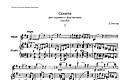
- Violin Sonata in E minor, Op. 82 (1918) Dedicated to Marie Joshua
- Soliloquy for solo oboe (1930)
All for piano unless otherwise indicated
- Cantique, Op. 3, for organ (1879; originally Adagio solonelle, arranged for orchestra 1912)
- Douce Pensée, for piano trio (1882); later orchestrated as Rosemary
- Griffinesque (1884)
- Presto (1889)
- 11 Vesper Voluntaries, Op. 14, for organ
- May-Song (1901)
- Concert Allegro, Op. 46 (1901; unpublished)
- Skizze (1903)
- In Smyrna (1905)
- Sonatina (pub. 1932)
- Adieu (pub. 1932)
- Serenade (pub. 1932)
- Organ Sonata in G Major, Op. 28
- Memorial Chimes for a Carillon (1923; composed for the opening of the Loughborough War Memorial Carillon)
- Severn Suite, Op. 87 (1930) (transcribed for orchestra in 1932)
Transcriptions and arrangements
- J. S. Bach, Fantasia and Fugue in C minor, BWV 537, transcription for orchestra, Op.86 (1921–1922)
- Hubert Parry, Jerusalem (1922)
- Handel, Overture in D minor (Overture to Chandos Anthem "In the Lord put I my Trust", HWV247), transcription for orchestra (1923)
- Chopin, Funeral March from the Piano Sonata No. 2 in B-flat minor Op. 35, transcription for orchestra (1933)
The above text is available under the Creative Commons Attribution-ShareAlike License ( creativecommons.org/licenses/by-sa/3.0/ ). It uses material from the Wikipedia article "Edward Elgar" ( en.wikipedia.org/wiki/Edward_Elgar ).
Other names
Sir Edward William Elgar, 1st Baronet, Edward Elgar, bg:Едуард Елгар, ko:에드워드 엘가, he:אדוארד אלגר, la:Eduardus Elgar, ja:エドワード・エルガー, ru:Элгар, Эдуард, zh:爱德华·埃尔加
All music
You may also find sheet music by Elgar on Sheet Music Plus.