Silent Night (Stille Nacht, heilige Nacht)
Easy piano
- Composer
- F X Gruber
- Pages
- 1
- Arranger
- Ian Cantor
- Instruments
- Piano
- Type
- Christmas Carol
- Difficulty
- Intermediate
- Licence
- Public domain
- Filesize
- 49.0 KB
Listen

- Silent Night for easy piano
- Piano
- Cantorion
- youtube.com
- Silent Night
- Choir
- King's College Choir
- Venue
- King's College Chapel
- youtube.com
Reviews
Click to rate
About
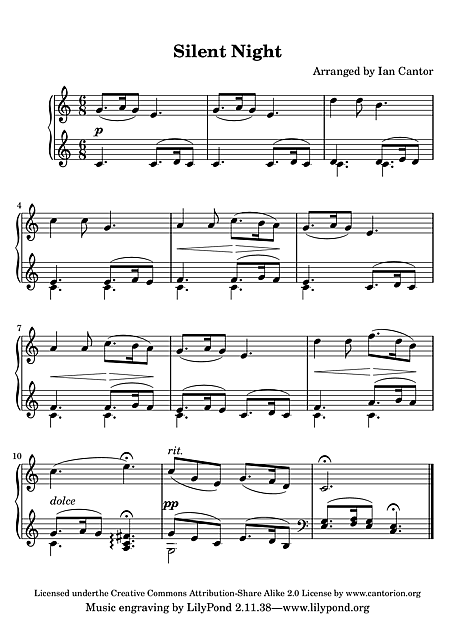
This is an arrangement of 'Silent Night' for grade 2-3 piano. Notice how the left hand uses the opening melodic over and over again. Try using the sustain pedal in this piece.
About Silent Night
"Silent Night" is a popular Christmas carol, composed in 1818 by Franz Xaver Gruber to lyrics by Joseph Mohr in the small town of Oberndorf bei Salzburg, Austria. It was declared an intangible cultural heritage by UNESCO in 2011. The song has been recorded by many singers across many music genres. The version sung by Bing Crosby in 1935 has sold 10 million copies as a single.
The above text from the Wikipedia article "Silent Night" text is available under CC BY-SA 3.0.
The above text from the Wikipedia article "Silent Night" text is available under CC BY-SA 3.0.
Other arrangements
- Easy Guitar
- Guitar
- ♪HQ
- Vocal line
- Voice
- HQ
- Orchestra
- Orchestra
- ♪HQ
- HQ
- ♪HQ
Free sheet music on other sites
Buy printed editions
We have selected some printed editions we think may be useful.
- Silent Night, Holy Night
- $1.60
- Choir, High Voice, Piano, Organ, Voice Solo
- Carl Fischer
- Silent Night
- $1.55
- A Cappella
- Hinshaw Music Inc.
- Silent Night
- $1.95
- Soprano Voice, Choir, Voice Solo
- E.C. Schirmer Publishing
- Silent Night, Holy Night
- $1.95
- Percussion, Handbell, Choir
- Hope Publishing Company
- Silent Night
- $2.95
- Piano Solo
- Alfred Music Publishing
- Silent Night, Holy Night
- $5.95
- Violin
- Majestic Music Publications
- Silent Night
- $16.95
- Clarinet quartet, Woodwind quartet, Clarinet
- Advance Music
Other users also liked
- ♪HQ
- Jingle Bells
Easy piano - James Lord Pierpont
- Piano
- Jingle Bells
- ♪HQ
- O Holy Night
Voice, Piano - Adolphe Charles Adam
- O Holy Night
- ♪HQ
- Happy Birthday Song
Voice, Piano - Mildred J. Hill
- Happy Birthday Song
- ♪HQ
- Jingle Bells
Beginner piano - James Lord Pierpont
- Piano
- Jingle Bells
- HQ
- Christmas Carol Songbook
Voice, SATB - Various
- Christmas Carol Songbook