Ave Maria
B flat major
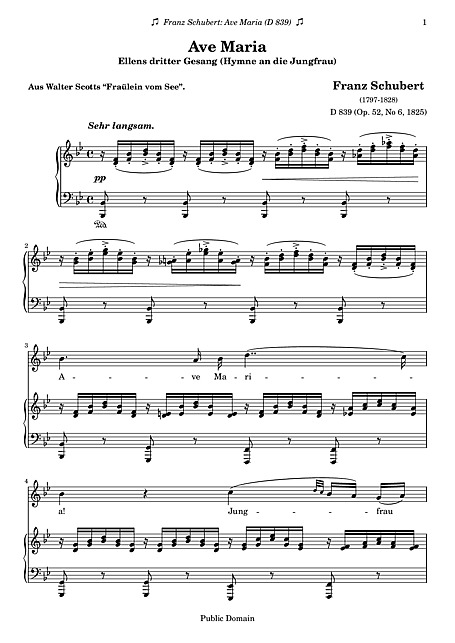
- Composer
- F P Schubert
- Opus
- D 839
- Pages
- 10
- Instruments
- Voice, Piano
- Type
- Classic
- Licence
- Public domain
- Uploaded by
- Music Library
- Filesize
- 852 KB
If you can't open this file, you'll need to install the Adobe Reader.
Listen
-
-
- Pavarotti - Ave Maria - Schubert
- Luciano Pavarotti in the Three Tenors concert 1994. youtube.com
-
-
-
- Ellens dritter Gesang
- archive.org
-
Reviews
Click to rate
-
“Beautiful”
-
“Muito bom!!!!”
- Language:
- Portuguese
- English
-
“Só tenho augo a dizer!
Sou apaixonado por música clássica.”- Language:
- Portuguese
- English
-
“very, very good music, I have heard it the 1st time when I was a child and now, after 45 years I feel the time did not pass at all.”
About
About Ave Maria
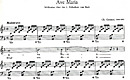
Ellens dritter Gesang (Ellens Gesang III, D839, Op 52 no 6, 1825), Ellen's third song in English, composed by Franz Schubert in 1825, is one of Schubert's most popular works, although some misconceptions exist regarding its provenance.
"The Lady of the Lake" and the "Ave Maria"
The piece is often referred to as Schubert's Ave Maria; but it was originally composed as a setting of a song from Walter Scott's popular epic poem The Lady of the Lake, in the German translation by Adam Storck (1780-1822) and thus forms part of Schubert's "Liederzyklus vom Fräulein vom See". In Scott's poem the character Ellen Douglas, the "Lady" of "the Lake" (Loch Katrine in the Scottish Highlands) has gone with her father to hide in the "Goblin's cave" nearby to avoid drawing the vengeance of the King on their host, the Clan-Alpine chieftain Roderick Dhu, who has been affording them shelter since the King had exiled them. She sings a prayer addressed to the Virgin Mary, calling upon her for help. Ellen is overheard by Roderick Dhu who is higher on the mountain, raising the clan for war.
The piece is said to have first been performed at the castle of Countess Sophie Weissenwolff in the little Austrian town Steyregg and dedicated to her, which led to her subsequently becoming known as the lady of the lake herself.
The opening words and refrain of Ellen's song, namely "Ave Maria" (Latin, "Hail Mary"), may have led to the idea of adapting Schubert's melody as a setting for the full text of the traditional Roman Catholic prayer Ave Maria. The Latin version of the Ave Maria is now so frequently used with Schubert's melody, that it has led to the misconception that he originally wrote the melody as a setting for the Ave Maria.
Recordings of the Latin version of Ave Maria set to Ellens dritter Gesang include:
Schubert composed in 1825 a selection of seven songs from Scott's The Lady of the Lake. They were published in 1826 as his op. 52. The songs are not intended for a single performer: the three songs of Ellen are piano songs for a woman's voice, the songs for Norman and the Count of Douglas ones were planned for the baritone Johann Michael Vogl. The remaining two songs are written for one male and a female ensemble.
The words of "Ellens dritter Gesang"
Use in Disney's Fantasia
Walt Disney used Schubert's song in the final part of Fantasia, where he chained it to Mussorgsky's Night on Bald Mountain, in one of his most famous pastiches. The end of Mussorgsky's work blends with almost no change right into the beginning of Schubert's song, and as Deems Taylor remarked, the bells in "Night on Bald Mountain", originally meant to signal the coming of dawn, now seem to be church bells signalling the beginning of religious services. The text for this version is sung in English, and was written by Rachel Field, who based it on Schubert's original. This version also had three verses, like Schubert's original, but only the third verse made it into the film (one line in the last verse is partially repeated to show how it is sung in the film):
Ave Maria! Now your ageless bell so sweetly sounds for listening ears, from heights of Heaven to brink of Hell in tender notes have echoed through the years. Aloft from earth's far boundaries Each poor petition, every prayer, the hopes of foolish ones and wise must mount in thanks or grim despair. Ave Maria!
Ave Maria! You were not spared one pang of flesh, or mortal tear; So rough the paths your feet have shared, So great the bitter burden of your fear. Your heart has bled with every beat. In dust you laid your weary head, the hopeless vigil of defeat was yours and flinty stone for bread Ave Maria!
Ave Maria! Heaven's Bride. The bells ring out in solemn praise, for you, the anguish and the pride. The living glory of our nights, of our nights and days. The Prince of Peace your arms embrace, while hosts of darkness fade and cower. Oh save us, mother full of grace, In life and in our dying hour, Ave Maria!
The arrangement was made by Leopold Stokowski especially for the film, and unlike the original, which is scored for a solo voice, the version heard in Fantasia is scored for soprano and mixed chorus, accompanied by the string section of the Philadelphia Orchestra. The soloist is Julietta Novis.
The liner notes for the soundtrack LP of Fantasia, released by Disneyland Records (mono) and Buena Vista Records (stereo), and the booklet for the CD, released by Walt Disney Records, do not contain the Rachel Field lyric.
Ave Maria (set to Schubert's music)
There is at least one additional set of lyrics for Schubert's Ave Maria / Ellens dritter Gesang. One particular set is used in an arrangement titled Ave Maria, performed by the Zurich Sängerknaben, with Daniel Perret as the soprano voice. Although less widespread in use, this set of lyrics received some attention due to its use as the theme song for the Hitman: Blood Money video game. A version is used in the soundtrack for the Hitman movie (a film based on the video game franchise), sung by Christina England. Contrary to popular belief, Jesper Kyd did not arrange either composition.
The 'Ave Maria' is used on the soundtracks of the popular computer games Raven Shield and Hitman: Blood Money
The above text is available under the Creative Commons Attribution-ShareAlike License ( creativecommons.org/licenses/by-sa/3.0/ ). It uses material from the Wikipedia article "Ellens dritter Gesang" ( en.wikipedia.org/wiki/Ellens_dritter_Gesang ).
"The Lady of the Lake" and the "Ave Maria"
The piece is often referred to as Schubert's Ave Maria; but it was originally composed as a setting of a song from Walter Scott's popular epic poem The Lady of the Lake, in the German translation by Adam Storck (1780-1822) and thus forms part of Schubert's "Liederzyklus vom Fräulein vom See". In Scott's poem the character Ellen Douglas, the "Lady" of "the Lake" (Loch Katrine in the Scottish Highlands) has gone with her father to hide in the "Goblin's cave" nearby to avoid drawing the vengeance of the King on their host, the Clan-Alpine chieftain Roderick Dhu, who has been affording them shelter since the King had exiled them. She sings a prayer addressed to the Virgin Mary, calling upon her for help. Ellen is overheard by Roderick Dhu who is higher on the mountain, raising the clan for war.
The piece is said to have first been performed at the castle of Countess Sophie Weissenwolff in the little Austrian town Steyregg and dedicated to her, which led to her subsequently becoming known as the lady of the lake herself.
The opening words and refrain of Ellen's song, namely "Ave Maria" (Latin, "Hail Mary"), may have led to the idea of adapting Schubert's melody as a setting for the full text of the traditional Roman Catholic prayer Ave Maria. The Latin version of the Ave Maria is now so frequently used with Schubert's melody, that it has led to the misconception that he originally wrote the melody as a setting for the Ave Maria.
Recordings of the Latin version of Ave Maria set to Ellens dritter Gesang include:
- Ave Maria by Stevie Wonder on the album Someday at Christmas, 1967
- Ave Maria by Perry Como on the album The Perry Como Christmas Album, 1968
- Ave Maria by José Carreras on the album Merry Christmas, 1986
- Ave Maria by Luciano Pavarotti on the album Oh Holy Night, 1990
- Ave Maria by Aaron Neville on the album Warm Your Heart, 1991
- Ave Maria by Frank Patterson on the album Amazing Grace, 1996
- Ave Maria by Barbra Streisand on the album Christmas Memories, 2001
- Ave Maria by Chanticleer on the album Let It Snow, 2007
- Ave Maria by Kousuke Atari on the album Yurai Hana, 2007
Schubert composed in 1825 a selection of seven songs from Scott's The Lady of the Lake. They were published in 1826 as his op. 52. The songs are not intended for a single performer: the three songs of Ellen are piano songs for a woman's voice, the songs for Norman and the Count of Douglas ones were planned for the baritone Johann Michael Vogl. The remaining two songs are written for one male and a female ensemble.
- Ellens Gesang I D 837 „Raste Krieger, Krieg ist aus“/„Soldier rest! the warfare o’er“
- Ellens Gesang II D 838 „Jäger, ruhe von der Jagd“/„Huntsman, rest! thy chase is done“
- Bootgesang D 835 „Triumph, er naht“/„Hail to the chief“, Männerquartett (TTBB)
- Coronach (Song of the dead of women and girls) D 836 „Er ist uns geschieden“/„He is gone to the mountain“, Chorlied (SSA)
- Normans Gesang D 846 „Die Nacht bricht bald herein“/„The night soon breaks in“
- Ellens Gesang III (Hymne an die Jungfrau) D 839 „Ave Maria! Jungfrau mild!“/„Ave Maria! maiden mild!“, Lied für Frauenstimme
- Lied des gefangenen Jägers D 843 „Mein Roß so müd“/„My steed is tired“
The words of "Ellens dritter Gesang"
Use in Disney's Fantasia
Walt Disney used Schubert's song in the final part of Fantasia, where he chained it to Mussorgsky's Night on Bald Mountain, in one of his most famous pastiches. The end of Mussorgsky's work blends with almost no change right into the beginning of Schubert's song, and as Deems Taylor remarked, the bells in "Night on Bald Mountain", originally meant to signal the coming of dawn, now seem to be church bells signalling the beginning of religious services. The text for this version is sung in English, and was written by Rachel Field, who based it on Schubert's original. This version also had three verses, like Schubert's original, but only the third verse made it into the film (one line in the last verse is partially repeated to show how it is sung in the film):
Ave Maria! Now your ageless bell so sweetly sounds for listening ears, from heights of Heaven to brink of Hell in tender notes have echoed through the years. Aloft from earth's far boundaries Each poor petition, every prayer, the hopes of foolish ones and wise must mount in thanks or grim despair. Ave Maria!
Ave Maria! You were not spared one pang of flesh, or mortal tear; So rough the paths your feet have shared, So great the bitter burden of your fear. Your heart has bled with every beat. In dust you laid your weary head, the hopeless vigil of defeat was yours and flinty stone for bread Ave Maria!
Ave Maria! Heaven's Bride. The bells ring out in solemn praise, for you, the anguish and the pride. The living glory of our nights, of our nights and days. The Prince of Peace your arms embrace, while hosts of darkness fade and cower. Oh save us, mother full of grace, In life and in our dying hour, Ave Maria!
The arrangement was made by Leopold Stokowski especially for the film, and unlike the original, which is scored for a solo voice, the version heard in Fantasia is scored for soprano and mixed chorus, accompanied by the string section of the Philadelphia Orchestra. The soloist is Julietta Novis.
The liner notes for the soundtrack LP of Fantasia, released by Disneyland Records (mono) and Buena Vista Records (stereo), and the booklet for the CD, released by Walt Disney Records, do not contain the Rachel Field lyric.
Ave Maria (set to Schubert's music)
There is at least one additional set of lyrics for Schubert's Ave Maria / Ellens dritter Gesang. One particular set is used in an arrangement titled Ave Maria, performed by the Zurich Sängerknaben, with Daniel Perret as the soprano voice. Although less widespread in use, this set of lyrics received some attention due to its use as the theme song for the Hitman: Blood Money video game. A version is used in the soundtrack for the Hitman movie (a film based on the video game franchise), sung by Christina England. Contrary to popular belief, Jesper Kyd did not arrange either composition.
The 'Ave Maria' is used on the soundtracks of the popular computer games Raven Shield and Hitman: Blood Money
The above text is available under the Creative Commons Attribution-ShareAlike License ( creativecommons.org/licenses/by-sa/3.0/ ). It uses material from the Wikipedia article "Ellens dritter Gesang" ( en.wikipedia.org/wiki/Ellens_dritter_Gesang ).
Buy printed editions
We have selected some printed editions we think may be useful.
-
- Ave Maria
- Price
- $1.70
- Instruments
- Violin, Piano, Flute, ...
- Publisher
- Hal Leonard
-
- Ave Maria (Op. 52, No. 6)
- Price
- $2.25
- Instruments
- Choral, Vocal
- Publisher
- Alfred Publishing
-
- Ave Maria (Shubert)
- Price
- $3.50
- Instruments
- Piano
- Publisher
- Santorella Publicati...
-
- Ave Maria
- Price
- $3.95
- Instruments
- Piano
- Publisher
- Santorella Publicati...
-
- Ave Maria for High Voices
- Price
- $3.95
- Instruments
- Piano, Vocal
- Publisher
- Santorella Publicati...
-
- Ave Maria
- Price
- $3.95
- Instruments
- Voice solo, Piano, Vo...
- Publisher
- G. Schirmer
-
- Ave Maria
- Price
- $3.95
- Instruments
- Piano, Vocal
- Publisher
- Alfred Publishing
-
- Ave Maria Op. 52, No. 6
- Price
- $3.95
- Instruments
- Voice solo, Piano, Vo...
- Publisher
- G. Schirmer
-
- Ave Maria
- Price
- $3.95
- Instruments
- Voice solo, Vocal
- Publisher
- G. Schirmer
-
- Ave Maria for Classical Guitar
- Price
- $3.95
- Instruments
- Guitar
- Publisher
- Santorella Publicati...
-
- Ave Maria (Op. 52)
- Price
- $3.95
- Instruments
- Guitar, Piano, Vocal
- Publisher
- Alfred Publishing
-
- Ave Maria for Low Voices
- Price
- $3.95
- Instruments
- Piano, Vocal
- Publisher
- Santorella Publicati...
-
- Ave Maria
- Price
- $3.95
- Instruments
- Piano
- Publisher
- Alfred Publishing
-
- Ave Maria
- Price
- $3.95
- Instruments
- Piano
- Publisher
- Hal Leonard
-
- Ave Maria
- Price
- $3.95
- Instruments
- Piano
- Publisher
- Alfred Publishing
-
- Ave Maria
- Price
- $6.95
- Instruments
- Voice solo, Vocal
- Publisher
- G. Schirmer
-
- Ave Maria
- Price
- $11.95
- Instruments
- Voice solo, Piano, Vo...
- Publisher
- Edition Peters
-
- The Complete Ave Maria
- Price
- $12.95
- Instruments
- Voice solo, Organ, Pi...
- Publisher
- Hal Leonard
-
- The Schubert Song Transcriptions For Solo Piano - Series I: "Ave Maria," "Erlkonig" And Ten Other Great Songs
- Price
- $15.95
- Instruments
- Piano
- Publisher
- Dover Publications