Piano Sonata No. 14 "Moonlight"
- Composer
- L v Beethoven
- Opus
- Op. 27/2
- Year composed
- 1801
- Pages
- 23
- Instruments
- Piano
- Type
- Classic
- Licence
- Creative Commons Attribution-ShareAlike 2.5
- Uploaded by
- Music Library
- Filesize
- 431 KB
If you can't open this file, you'll need to install the Adobe Reader.
Listen
-
- Moonlight Sonata
- archive.org
-
-
- Moonlight Sonata 3rd mvt
- upload.wikimedia.org
-
-
- Moonlight Sonata 2nd mvt
- upload.wikimedia.org
-
-
- Moonlight Sonata 1st mvt
- upload.wikimedia.org
-
-
-
- Wilhelm Kempff plays Moonlight Sonata
- Wilhelm Kempff plays Beethoven's Moonlight Sonata mvt. 1. youtube.com
-
-
Reviews
Click to rate
-
“In my opinion, one of the greatest pieces of music ever composed. This is what inspired me to learn to play the piano. Absolutely wonderful to finally find this score.”
-
“best and sadest piece for piano”
-
“great!”
-
“is beautiful i like it”
About
About Piano Sonata No. 14 "Moonlight"
The Piano Sonata No. 14 in C-sharp minor "Quasi una fantasia", Op. 27, No. 2, by Ludwig van Beethoven, popularly known as the Moonlight Sonata (Mondscheinsonate in German), was completed in 1801. It is rumored to be dedicated to his pupil, 17-year-old Countess Giulietta Guicciardi, with whom Beethoven was, or had been, in love. The name "Moonlight" Sonata derives from an 1832 description of the first movement by music critic Ludwig Rellstab, who compared it to moonlight shining upon Lake Lucerne.
Beethoven included the phrase "Quasi una fantasia" (Italian: Almost a fantasy) in the title partly because the sonata does not follow the traditional sonata pattern where the first movement is in regular sonata form, and where the three or four movements are arranged in a fast-slow--fast sequence. Instead, the Moonlight sonata possesses an end-weighted trajectory; the climax is held off until the third movement. To be sure, the deviation from traditional sonata form is intentional. In his analysis of the Moonlight sonata, German critic Paul Bekker states that “The opening sonata-allegro movement gave the work a definite character from the beginning…which succeeding movements could supplement but not change. Beethoven rebelled against this determinative quality in the first movement. He wanted a prelude, an introduction, not a proposition.” By placing the most dramatic form (sonata form) at the end of the piece, Beethoven could magnify the drama inherent in the form.
Form
The sonata has three movements:
The second movement is a relatively conventional scherzo and trio; a moment of relative calm written in D-flat major, the enharmonic equivalent of C-sharp major, the parallel major of C-sharp minor. This replaces 7 sharps (C-sharp major) with 5 flats (D-flat major), granting less confusion when reading the music. Franz Liszt described the second movement as "a flower between two chasms."
The stormy final movement (C-sharp minor), in sonata form, is the weightiest of the three, reflecting an experiment of Beethoven's (also carried out in the companion sonata, Opus 27, No. 1 and later on in Opus 101) placement of the most important movement of the sonata last. The writing has many fast arpeggios and strongly accented notes, and an effective performance demands lively and skillful playing.
Of the final movement, Charles Rosen has written "it is the most unbridled in its representation of emotion. Even today, two hundred years later, its ferocity is astonishing."
It is thought that the C-sharp minor sonata, particularly the third movement, was the inspiration for Frédéric Chopin's Fantaisie-Impromptu. The Fantaisie-Impromptu is also in the key of C-sharp minor, with a middle section of D-flat major, similar to the three movements of this sonata.
The musical dynamic that predominates in the third movement is in fact piano. It seems that Beethoven's heavy use of sforzando notes, together with just a few strategically located fortissimo passages, creates the sense of a very powerful sound in spite of the overall dynamic.
Beethoven's pedal mark
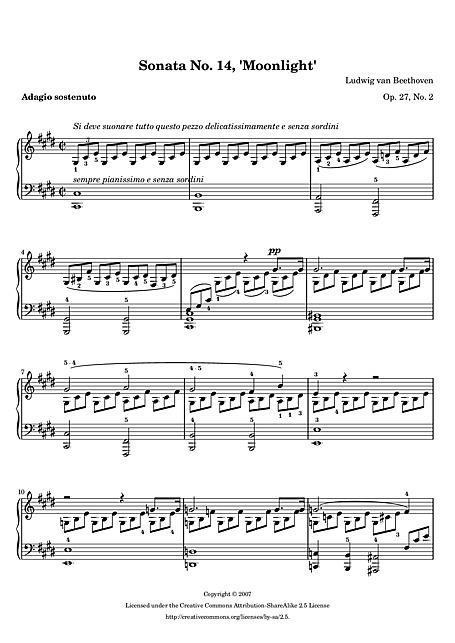
At the opening of the work, Beethoven included a written direction that the sustain pedal should be depressed for the entire duration of the first movement. The Italian reads: "Si deve suonare tutto questo pezzo delicatissimamente e senza sordino" ("One must play this whole piece very delicately and without dampers."). The modern piano has a much longer sustain time than the instruments of Beethoven's day. Therefore, his instruction cannot be followed by pianists playing modern instruments without creating an unpleasantly dissonant sound.
One option for dealing with this problem is to perform the work on a restored or replicated piano of the kind Beethoven knew. Proponents of historically informed performance using such pianos have found it feasible to perform the work respecting Beethoven's original direction.
For performance on the modern piano, most performers today try to achieve an effect similar to what Beethoven asked for using pedal changes only where necessary to avoid excessive dissonance. For instance, the Ricordi edition of the score posted at the external link given below does include pedal marks throughout the first movement. These are the work of a 20th century editor, meant to facilitate performance on a modern instrument. "Half pedaling"—a technique involving a partial depression of the damper pedal—is also often used to simulate the shorter sustain of the early nineteenth century pedal. Charles Rosen suggests both half-pedaling and releasing the pedal a fraction of a second late. Banowetz offers a further suggestion: to pedal cleanly while allowing sympathetic vibration of the low bass strings to provide the desired "blur." This is accomplished before beginning the movement by silently depressing the piano's lowest bass notes and then holding these dampers up with the middle pedal for the duration of the movement.
The above text is available under the Creative Commons Attribution-ShareAlike License ( creativecommons.org/licenses/by-sa/3.0/ ). It uses material from the Wikipedia article "Piano Sonata No. 14 (Beethoven)" ( en.wikipedia.org/ ... o_Sonata_No._14_(Beethoven) ).
Beethoven included the phrase "Quasi una fantasia" (Italian: Almost a fantasy) in the title partly because the sonata does not follow the traditional sonata pattern where the first movement is in regular sonata form, and where the three or four movements are arranged in a fast-slow--fast sequence. Instead, the Moonlight sonata possesses an end-weighted trajectory; the climax is held off until the third movement. To be sure, the deviation from traditional sonata form is intentional. In his analysis of the Moonlight sonata, German critic Paul Bekker states that “The opening sonata-allegro movement gave the work a definite character from the beginning…which succeeding movements could supplement but not change. Beethoven rebelled against this determinative quality in the first movement. He wanted a prelude, an introduction, not a proposition.” By placing the most dramatic form (sonata form) at the end of the piece, Beethoven could magnify the drama inherent in the form.
Form
The sonata has three movements:
- Adagio sostenuto
- Allegretto
- Presto agitato
The second movement is a relatively conventional scherzo and trio; a moment of relative calm written in D-flat major, the enharmonic equivalent of C-sharp major, the parallel major of C-sharp minor. This replaces 7 sharps (C-sharp major) with 5 flats (D-flat major), granting less confusion when reading the music. Franz Liszt described the second movement as "a flower between two chasms."
The stormy final movement (C-sharp minor), in sonata form, is the weightiest of the three, reflecting an experiment of Beethoven's (also carried out in the companion sonata, Opus 27, No. 1 and later on in Opus 101) placement of the most important movement of the sonata last. The writing has many fast arpeggios and strongly accented notes, and an effective performance demands lively and skillful playing.
Of the final movement, Charles Rosen has written "it is the most unbridled in its representation of emotion. Even today, two hundred years later, its ferocity is astonishing."
It is thought that the C-sharp minor sonata, particularly the third movement, was the inspiration for Frédéric Chopin's Fantaisie-Impromptu. The Fantaisie-Impromptu is also in the key of C-sharp minor, with a middle section of D-flat major, similar to the three movements of this sonata.
The musical dynamic that predominates in the third movement is in fact piano. It seems that Beethoven's heavy use of sforzando notes, together with just a few strategically located fortissimo passages, creates the sense of a very powerful sound in spite of the overall dynamic.
Beethoven's pedal mark
At the opening of the work, Beethoven included a written direction that the sustain pedal should be depressed for the entire duration of the first movement. The Italian reads: "Si deve suonare tutto questo pezzo delicatissimamente e senza sordino" ("One must play this whole piece very delicately and without dampers."). The modern piano has a much longer sustain time than the instruments of Beethoven's day. Therefore, his instruction cannot be followed by pianists playing modern instruments without creating an unpleasantly dissonant sound.
One option for dealing with this problem is to perform the work on a restored or replicated piano of the kind Beethoven knew. Proponents of historically informed performance using such pianos have found it feasible to perform the work respecting Beethoven's original direction.
For performance on the modern piano, most performers today try to achieve an effect similar to what Beethoven asked for using pedal changes only where necessary to avoid excessive dissonance. For instance, the Ricordi edition of the score posted at the external link given below does include pedal marks throughout the first movement. These are the work of a 20th century editor, meant to facilitate performance on a modern instrument. "Half pedaling"—a technique involving a partial depression of the damper pedal—is also often used to simulate the shorter sustain of the early nineteenth century pedal. Charles Rosen suggests both half-pedaling and releasing the pedal a fraction of a second late. Banowetz offers a further suggestion: to pedal cleanly while allowing sympathetic vibration of the low bass strings to provide the desired "blur." This is accomplished before beginning the movement by silently depressing the piano's lowest bass notes and then holding these dampers up with the middle pedal for the duration of the movement.
The above text is available under the Creative Commons Attribution-ShareAlike License ( creativecommons.org/licenses/by-sa/3.0/ ). It uses material from the Wikipedia article "Piano Sonata No. 14 (Beethoven)" ( en.wikipedia.org/ ... o_Sonata_No._14_(Beethoven) ).
Other arrangements
-

-
Piano Sonata No. 14 "Moonlight"
Original version - Composer
- Ludwig van Beethoven
- Instruments
- Piano
- Opus
- Op. 27/2
- Rating
-
Piano Sonata No. 14 "Moonlight"
-
-
Piano Sonata No. 14 "Moonlight"
Guitar arrangement - Composer
- Ludwig van Beethoven
- Instruments
- Guitar
- Opus
- Op. 27/2
- Rating
-
Piano Sonata No. 14 "Moonlight"
Buy printed editions
We have selected some printed editions we think may be useful.
-
- Moonlight Sonata - 1st Movement - Easy Piano
- Price
- $3.95
- Instruments
- Piano
- Publisher
- Hal Leonard
-
- Moonlight Sonata
- Price
- $3.95
- Instruments
- Guitar
- Publisher
- Alfred Publishing
-
- Moonlight Sonata (Sonata No. 14 in C-Sharp Minor, Op. 27, No. 2)
- Price
- $5.95
- Instruments
- Piano
- Publisher
- Alfred Publishing
-
- Moonlight Sonata for Alto Sax & Piano
- Price
- $6.95
- Instruments
- Alto saxophone, Saxo...
- Publisher
- Santorella Publicati...
-
- Moonlight Sonata For Flute & Piano
- Price
- $6.95
- Instruments
- Piano, Flute
- Publisher
- Santorella Publicati...
-
- Adagio from the "Moonlight Sonata"
- Price
- $7.00
- Instruments
- Violin, Piano
- Publisher
- Wiltshire Music/Cor ...
-
- Moonlight Sonata * Complete Original *..with Performance CD
- Price
- $14.95
- Publisher
- Santorella Publicati...
-
- Moonlight Sonata, Movements 1 and 2
- Price
- $16.95
- Instruments
- Violin, Cello, Viola, ...
- Publisher
- Broadbent & Dunn