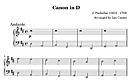
Canon in D
Easy violin
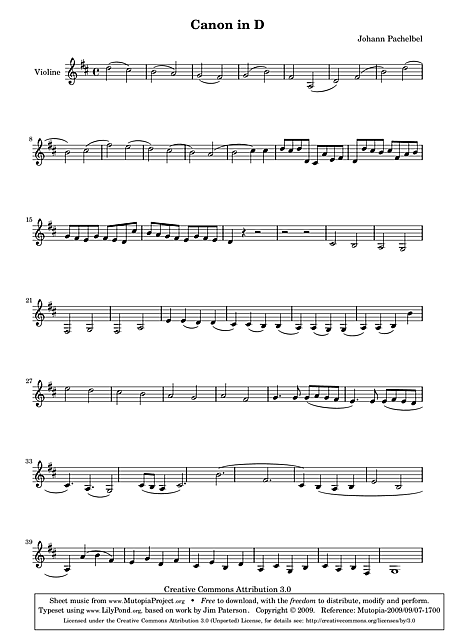
- Composer
- J Pachelbel
- Tonality
- D major
- Pages
- 1
- Instruments
- Violin
- Difficulty
- Easy
- Licence
- Creative Commons Attribution 3.0
- Uploaded by
- Music Library
- Filesize
- 45.3 KB
If you can't open this file, you'll need to install the Adobe Reader.
Reviews
Click to rate
-
“horrivel, naum tm nada a ver”
- Language:
- Portuguese
- English
-
“muito bom........”
- Language:
- Portuguese
- English
About
About Canon in D
Pachelbel's Canon, also known as Canon in D major (PWC 37, T. 337, PC 358), is the most famous piece of music by German Baroque composer Johann Pachelbel. It was originally scored for three violins and basso continuo and paired with a gigue in the same key. Like most other works by Pachelbel and other pre-1700 composers, the Canon remained forgotten for centuries and was rediscovered only in the 20th century. Several decades after it was first published in 1919, the piece became extremely popular, and today it is frequently played at weddings and included on classical music compilations, along with other famous Baroque pieces such as Air on the G String by Johann Sebastian Bach.
History of composition and publication
Although Pachelbel was renowned in his lifetime for his chamber works (contemporary sources praise his serenades and sonatas), most of them were lost. Only Musikalische Ergötzung, a collection of partitas published during Pachelbel's lifetime, is known, and a few isolated pieces in manuscripts. Canon and Gigue in D major is one of such pieces. A single manuscript copy of it survives, Mus.MS 16481 in the Berlin State Library, which contains two more chamber suites; another copy, previously kept in Hochschule der Künste in Berlin, is now lost. The circumstances of the piece's composition are wholly unknown. One writer hypothesized that the Canon may have been composed for Johann Christoph Bach's wedding, on 23 October 1694, which Pachelbel attended. The music for the occasion was provided by Johann Ambrosius Bach, Pachelbel, and other friends and family members. Johann Christoph Bach was a former pupil of Pachelbel's, and Johann Sebastian Bach's oldest brother.
The Canon (without the accompanying gigue) was first published in 1919 by scholar Gustav Beckmann, who included the score in his article on Pachelbel's chamber music. His research was inspired and supported by renowned early music scholar and editor Max Seiffert, who in 1925 published his arrangement of Canon and Gigue in his Organum series. However, that edition contained numerous articulation marks and dynamics not found in the original score; furthermore, Seiffert provided tempi which he considered right for the piece, but which were not supported by later research. The Canon was first recorded in 1940 by Arthur Fiedler, and the first famous recording of the piece was made by the Jean-François Paillard chamber orchestra.
Over the years, the Canon has been arranged numerous times for a wide variety of ensembles. A non-original viola pizzicato part is also commonly added (in a string orchestra or quartet setting) when a harpsichord or organ player is not used to improvise harmonies over the bass line. The Canon's chord progression proved to be immensely influential; it was used in countless pop and rock songs.
The Canon enjoyed a surge in popularity after it appeared in the movie Ordinary People; it is said to have become the most popular piece of classical music, however briefly. Since then, it has appeared in numerous settings and arrangements, including with lyrics.
Analysis
Pachelbel's Canon is a complex work which merges several distinct forms of music. The canon is a polyphonic form in which several voices play the same music, only enter one by one, each after a delay. In Pachelbel's piece, there are three voices engaged in canon (see Example 1), but there is also a fourth voice, the basso continuo, which plays an independent part.
The bass voice keeps repeating the same two-bar line throughout the piece. In musicology, this is commonly referred to as ostinato, or ground bass (see Example 2). The chords suggested by this bass are:
In Germany, Italy, and France of the 17th century, some pieces built on ground bass were called chaconnes or passacaglias; such ground-bass works would most frequently incorporate some form of variation in the upper voices. In Pachelbel's piece this happens in violin lines. There are 12 variations in all, each four bars long. They are described by scholar Kathryn J. Welter thus:
The convention in the Baroque era would have been to play a piece of this type in the moderate to fast tempo. It became fashionable in the 20th and 21st centuries to play the work at a very slow tempo, often as slow as 40 bpm, although faster renditions are occasionally heard.
Media
The above text is available under the Creative Commons Attribution-ShareAlike License ( creativecommons.org/licenses/by-sa/3.0/ ). It uses material from the Wikipedia article "Pachelbel's Canon" ( en.wikipedia.org/ ... wiki/Pachelbel's_Canon ).
History of composition and publication
Although Pachelbel was renowned in his lifetime for his chamber works (contemporary sources praise his serenades and sonatas), most of them were lost. Only Musikalische Ergötzung, a collection of partitas published during Pachelbel's lifetime, is known, and a few isolated pieces in manuscripts. Canon and Gigue in D major is one of such pieces. A single manuscript copy of it survives, Mus.MS 16481 in the Berlin State Library, which contains two more chamber suites; another copy, previously kept in Hochschule der Künste in Berlin, is now lost. The circumstances of the piece's composition are wholly unknown. One writer hypothesized that the Canon may have been composed for Johann Christoph Bach's wedding, on 23 October 1694, which Pachelbel attended. The music for the occasion was provided by Johann Ambrosius Bach, Pachelbel, and other friends and family members. Johann Christoph Bach was a former pupil of Pachelbel's, and Johann Sebastian Bach's oldest brother.
The Canon (without the accompanying gigue) was first published in 1919 by scholar Gustav Beckmann, who included the score in his article on Pachelbel's chamber music. His research was inspired and supported by renowned early music scholar and editor Max Seiffert, who in 1925 published his arrangement of Canon and Gigue in his Organum series. However, that edition contained numerous articulation marks and dynamics not found in the original score; furthermore, Seiffert provided tempi which he considered right for the piece, but which were not supported by later research. The Canon was first recorded in 1940 by Arthur Fiedler, and the first famous recording of the piece was made by the Jean-François Paillard chamber orchestra.
Over the years, the Canon has been arranged numerous times for a wide variety of ensembles. A non-original viola pizzicato part is also commonly added (in a string orchestra or quartet setting) when a harpsichord or organ player is not used to improvise harmonies over the bass line. The Canon's chord progression proved to be immensely influential; it was used in countless pop and rock songs.
The Canon enjoyed a surge in popularity after it appeared in the movie Ordinary People; it is said to have become the most popular piece of classical music, however briefly. Since then, it has appeared in numerous settings and arrangements, including with lyrics.
Analysis
Pachelbel's Canon is a complex work which merges several distinct forms of music. The canon is a polyphonic form in which several voices play the same music, only enter one by one, each after a delay. In Pachelbel's piece, there are three voices engaged in canon (see Example 1), but there is also a fourth voice, the basso continuo, which plays an independent part.
The bass voice keeps repeating the same two-bar line throughout the piece. In musicology, this is commonly referred to as ostinato, or ground bass (see Example 2). The chords suggested by this bass are:
- D major (tonic),
- A major (dominant),
- B minor (tonic relative or submediant—the relative minor tonic),
- F-sharp minor (dominant parallel or mediant—the relative minor dominant),
- G major (subdominant),
- D major (tonic),
- G major (subdominant), and
- A major (dominant)
In Germany, Italy, and France of the 17th century, some pieces built on ground bass were called chaconnes or passacaglias; such ground-bass works would most frequently incorporate some form of variation in the upper voices. In Pachelbel's piece this happens in violin lines. There are 12 variations in all, each four bars long. They are described by scholar Kathryn J. Welter thus:
- quarter notes
- eighth notes
- sixteenth notes
- leaping quarter notes, rest
- 32nd-note pattern on scalar melody
- staccato, eighth notes and rests
- 16th-note extensions of melody with upper neighbor notes
- repetitive sixteenth note patterns
- dotted rhythms
- dotted rhythms and 16th-note patterns on upper neighbor tones
- syncopated quarter and eighth notes rhythm
- eighth-note octave leaps
The convention in the Baroque era would have been to play a piece of this type in the moderate to fast tempo. It became fashionable in the 20th and 21st centuries to play the work at a very slow tempo, often as slow as 40 bpm, although faster renditions are occasionally heard.
Media
The above text is available under the Creative Commons Attribution-ShareAlike License ( creativecommons.org/licenses/by-sa/3.0/ ). It uses material from the Wikipedia article "Pachelbel's Canon" ( en.wikipedia.org/ ... wiki/Pachelbel's_Canon ).
Other arrangements
-


-
Canon in D
Easy piano - Composer
- Johann Pachelbel
- Instruments
- Piano
- Rating
-
Canon in D
-

-
Canon in D
Full score - Composer
- Johann Pachelbel
- Instruments
- String Quartet, Harpsichord
- Rating
-
Canon in D
-

-
Canon in D
Easy duet - Composer
- Johann Pachelbel
- Instruments
- Violin, Cello
- Rating
-
Canon in D
-

-
Canon in D
- Composer
- Johann Pachelbel
- Instruments
- Trumpet
-
Canon in D
Buy printed editions
We have selected some printed editions we think may be useful.
-
- Canon in D SATB
- Price
- $1.75
- Instruments
- Choral, Vocal
- Publisher
- Shawnee Press
-
- Canon in D TTBB
- Price
- $1.75
- Instruments
- Mens choir, Choral, ...
- Publisher
- Shawnee Press
-
- Canon In D for Easy Guitar
- Price
- $3.95
- Instruments
- Guitar
- Publisher
- Santorella Publicati...
-
- Canon In D
- Price
- $3.95
- Instruments
- Piano
- Publisher
- Alfred Publishing
-
- Canon In D - Easy Piano
- Price
- $3.95
- Instruments
- Piano
- Publisher
- Alfred Publishing
-
- Canon in D
- Price
- $3.95
- Instruments
- Guitar
- Publisher
- Alfred Publishing
-
- Canon in D
- Price
- $3.95
- Instruments
- Organ
- Publisher
- Alfred Publishing
-
- Canon In D
- Price
- $5.95
- Instruments
- Piano, Piano duet
- Publisher
- Alfred Publishing
-
- Canon In D For Trumpet And Organ
- Price
- $6.95
- Instruments
- Organ, Trumpet
- Publisher
- Unity Music Press
-
- Canon In D For Flute And Organ
- Price
- $6.95
- Instruments
- Organ, Flute
- Publisher
- Unity Music Press
-
- Canon In D
- Price
- $7.50
- Instruments
- Woodwind quartet, Fl...
- Publisher
- Kendor Music Inc
-
- Canon In D
- Price
- $7.95
- Instruments
- Piano
- Publisher
- Amsco
-
- Canon in D
- Price
- $7.95
- Instruments
- Percussion
- Publisher
- Alfred Publishing
-
- Canon in D for Cello Quartet
- Price
- $10.95
- Instruments
- Cello
- Publisher
- Latham Music Enterpr...
-
- Canon In D
- Price
- $14.95
- Publisher
- River Song Productio...
-
- Pachabel's Canon in D and Gathered in the Love of Christ
- Price
- $15.00
- Instruments
- Oboe, Guitar, Organ, P...
- Publisher
- GIA Publications