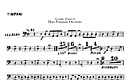
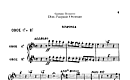
La fille du régiment
Overture
- Composer
- D G M Donizetti
- Type
- Opera
- Pages
- 8
- Arranger
- Gustav Blasser
- Instruments
- Piano
- Licence
- Public domain
- Uploaded by
- Music Library
- Filesize
- 1.29 MB
If you can't open this file, you'll need to install the Adobe Reader.
Reviews
Click to rate
No reviews yet
Add review
About La fille du régiment
La fille du régiment (The Daughter of the Regiment) is an opéra comique in two acts by Gaetano Donizetti. It was written while the composer was living in Paris, with a French libretto by Jules-Henri Vernoy de Saint-Georges and Jean-François Bayard. A slightly different Italian-language version (in translation by Callisto Bassi) was adapted to the tastes of the Italian public.
Performance history
La fille du régiment was first performed on February 11, 1840, at the Opéra-Comique, Paris, then at La Scala, Milan, October 30, 1840. It was presented in English at the Surrey Theatre in London on December 21, 1847, and was repeated in the same season in Italian with Jenny Lind. New Orleans saw the first American performance on March 7, 1843. It was frequently performed in New York, the role of Marie being a favorite with Jenny Lind, Henriette Sontag, Pauline Lucca, and Adelina Patti. It was presented at the Metropolitan Opera with Marcella Sembrich, and Charles Gilibert (Sulpice) in 1902-3. It was then at the Manhattan Opera House in 1909 with Luisa Tetrazzini, John McCormack, and Charles Gilibert, and again with Frieda Hempel and Antonio Scotti in the same roles at the Met on December 17, 1917.
This opera is famous for the aria "Ah! mes amis, quel jour de fête!" (sometimes referred to as "Pour mon âme"), which has been called the "Mount Everest" for tenors. It features nine high Cs and comes comparatively early in the opera, giving the singer less time to warm up his voice. Many lesser tenors do not quite hit the notes (hitting B natural instead), especially as they come in rapid-fire succession and require considerable vocal dexterity. Luciano Pavarotti's stardom is reckoned from a performance alongside Joan Sutherland at the Met, when he "leapt over the 'Becher's Brook' of the string of high Cs with an aplomb that left everyone gasping."
More recently, Juan Diego Florez performed "Ah! mes amis" at La Scala, and then, on popular demand, repeated it, "breaking a 74-year embargo on encores at the legendary Milanese opera house." He repeated this feat at the Met on April 21, 2008, the opening night of a new production with Natalie Dessay as Marie. This Met production was broadcast in high definition video to movie theaters worldwide on April 26, 2008. The recent production was updated in time to World War I with a tankette appearing in the finale.
Roles
Synopsis
Act 1
The Tyrolean mountains
On their way to Austria, the terrified Marquise of Berkenfeld and her butler, Hortensius, have paused in their journey because a skirmish has broken out. When the Marquise hears from the villagers that the French troops have retreated, she comments on the rude manners of the French people (“Pour une femme de mon nom”). Sulpice, sergeant of the 21st regiment, assures everyone that his men will restore peace and order. He is joined by Marie, the mascot, or “daughter,” of the regiment, which adopted her as an orphaned child. When Sulpice questions her about a young man she has been seen with, she explains that he is Tonio, a local Tyrolean who once saved her life. Troops of the 21st arrive with a prisoner: this same Tonio, who says he has been looking for Marie. She steps in to save him, and while he toasts his new friends, Marie sings the regimental song (“Chacun le sait”). Tonio is ordered to follow the soldiers, but he escapes and returns to declare his love to Marie. Sulpice surprises them, and Marie must admit to Tonio that she can marry only a soldier of the 21st.
The Marquise asks Sulpice for an escort to her castle. When he hears the name Berkenfeld, Sulpice remembers a letter he found near the young Marie on the battlefield. The Marquise soon admits that she knew the girl’s father and says that Marie is the long-lost daughter of her sister. The child had been left in the care of the Marquise, but was lost. Shocked by the girl’s rough manners, the Marquise is determined to take her niece to her castle and give her a proper education. Tonio has enlisted so that he can marry her (“Ah, mes amis”). But Marie has to leave both her regiment and the man she loves (“Il faut partir”).
Act 2
Berkenfeld Castle
The Marquise has arranged a marriage between Marie and the Duke of Krakenthorp. Sulpice is also at the castle, recovering from an injury, and is supposed to be helping the Marquise with her plans. The Marquise gives Marie a singing lesson, accompanying her at the piano. Encouraged by Sulpice, Marie slips in phrases of the regimental song, and the Marquise loses her temper (Trio: “Le jour naissait dans la bocage”). Left alone, Marie thinks about the meaninglessness of money and position (“Par le rang et l’opulence”). She hears soldiers marching in the distance and is delighted when the whole regiment files into the hall; she leads them in singing a patriotic tribute ("Salut à la France"). Tonio, Marie, and Sulpice are reunited. Tonio asks for Marie’s hand. The Marquise is unmoved by the young man’s declaration that Marie is his whole life (“Pour me rapprocher de Marie”). She declares her niece engaged to another man and dismisses Tonio. Alone with Sulpice, the Marquise confesses the truth: Marie is her own illegitimate daughter whom she abandoned, fearing social disgrace.
Hortensius announces the arrival of the wedding party, headed by the groom’s mother, the Duchess of Krakenthorp. Marie refuses to leave her room, but when Sulpice tells her that the Marquise is her mother, the surprised girl declares that she cannot go against her mother’s wishes and agrees to marry a man that she does not love. As she is about to sign the marriage contract, the soldiers of the 21st, led by Tonio, storm in to rescue their “daughter.” The guests are horrified to learn that Marie was a canteen girl, but they change their opinion when she tells them that she can never repay the debt she owes the soldiers. The Marquise is so moved by her daughter’s goodness of heart that she gives her permission to marry Tonio. Everyone joins in a final “Salut à la France.”
Libretto
Lina Pagliughi, Cesare Valletti, Sesto Bruscantini, Rina Corsi - Coro e Orchestra Lirica della Rai Milano, Mario Rossi (1950) Warner-Fonit (sung in Italian).
Joan Sutherland, Luciano Pavarotti, Spiro Malas, Monica Sinclair, Edith Coates - Orchestra and Chorus of The Royal Opera House, Covent Garden, cond. Richard Bonynge, London, 1968, Decca
June Anderson, Alfredo Kraus, Antoine Garcin, Hélia T'Hézan, Jean-Noël Bèguelin - Choeurs & Orchestre du Théâtre National de l'Opéra de Paris, cond. Bruno Campanella. Paris, 1986, EMI.
Edita Gruberová, Deon Van der Walt, Hans Werner Bunz, Paul Hansen, Philippe Fourcade, Rosa Laghezza - Bavarian Radio Chorus, Munich Radio Orchestra, cond. Marcello Panni. Munich. Nightingale.
Media
The above text is available under the Creative Commons Attribution-ShareAlike License ( creativecommons.org/licenses/by-sa/3.0/ ). It uses material from the Wikipedia article "La fille du régiment" ( en.wikipedia.org/wiki/La_fille_du_r ).
Performance history
La fille du régiment was first performed on February 11, 1840, at the Opéra-Comique, Paris, then at La Scala, Milan, October 30, 1840. It was presented in English at the Surrey Theatre in London on December 21, 1847, and was repeated in the same season in Italian with Jenny Lind. New Orleans saw the first American performance on March 7, 1843. It was frequently performed in New York, the role of Marie being a favorite with Jenny Lind, Henriette Sontag, Pauline Lucca, and Adelina Patti. It was presented at the Metropolitan Opera with Marcella Sembrich, and Charles Gilibert (Sulpice) in 1902-3. It was then at the Manhattan Opera House in 1909 with Luisa Tetrazzini, John McCormack, and Charles Gilibert, and again with Frieda Hempel and Antonio Scotti in the same roles at the Met on December 17, 1917.
This opera is famous for the aria "Ah! mes amis, quel jour de fête!" (sometimes referred to as "Pour mon âme"), which has been called the "Mount Everest" for tenors. It features nine high Cs and comes comparatively early in the opera, giving the singer less time to warm up his voice. Many lesser tenors do not quite hit the notes (hitting B natural instead), especially as they come in rapid-fire succession and require considerable vocal dexterity. Luciano Pavarotti's stardom is reckoned from a performance alongside Joan Sutherland at the Met, when he "leapt over the 'Becher's Brook' of the string of high Cs with an aplomb that left everyone gasping."
More recently, Juan Diego Florez performed "Ah! mes amis" at La Scala, and then, on popular demand, repeated it, "breaking a 74-year embargo on encores at the legendary Milanese opera house." He repeated this feat at the Met on April 21, 2008, the opening night of a new production with Natalie Dessay as Marie. This Met production was broadcast in high definition video to movie theaters worldwide on April 26, 2008. The recent production was updated in time to World War I with a tankette appearing in the finale.
Roles
Synopsis
Act 1
The Tyrolean mountains
On their way to Austria, the terrified Marquise of Berkenfeld and her butler, Hortensius, have paused in their journey because a skirmish has broken out. When the Marquise hears from the villagers that the French troops have retreated, she comments on the rude manners of the French people (“Pour une femme de mon nom”). Sulpice, sergeant of the 21st regiment, assures everyone that his men will restore peace and order. He is joined by Marie, the mascot, or “daughter,” of the regiment, which adopted her as an orphaned child. When Sulpice questions her about a young man she has been seen with, she explains that he is Tonio, a local Tyrolean who once saved her life. Troops of the 21st arrive with a prisoner: this same Tonio, who says he has been looking for Marie. She steps in to save him, and while he toasts his new friends, Marie sings the regimental song (“Chacun le sait”). Tonio is ordered to follow the soldiers, but he escapes and returns to declare his love to Marie. Sulpice surprises them, and Marie must admit to Tonio that she can marry only a soldier of the 21st.
The Marquise asks Sulpice for an escort to her castle. When he hears the name Berkenfeld, Sulpice remembers a letter he found near the young Marie on the battlefield. The Marquise soon admits that she knew the girl’s father and says that Marie is the long-lost daughter of her sister. The child had been left in the care of the Marquise, but was lost. Shocked by the girl’s rough manners, the Marquise is determined to take her niece to her castle and give her a proper education. Tonio has enlisted so that he can marry her (“Ah, mes amis”). But Marie has to leave both her regiment and the man she loves (“Il faut partir”).
Act 2
Berkenfeld Castle
The Marquise has arranged a marriage between Marie and the Duke of Krakenthorp. Sulpice is also at the castle, recovering from an injury, and is supposed to be helping the Marquise with her plans. The Marquise gives Marie a singing lesson, accompanying her at the piano. Encouraged by Sulpice, Marie slips in phrases of the regimental song, and the Marquise loses her temper (Trio: “Le jour naissait dans la bocage”). Left alone, Marie thinks about the meaninglessness of money and position (“Par le rang et l’opulence”). She hears soldiers marching in the distance and is delighted when the whole regiment files into the hall; she leads them in singing a patriotic tribute ("Salut à la France"). Tonio, Marie, and Sulpice are reunited. Tonio asks for Marie’s hand. The Marquise is unmoved by the young man’s declaration that Marie is his whole life (“Pour me rapprocher de Marie”). She declares her niece engaged to another man and dismisses Tonio. Alone with Sulpice, the Marquise confesses the truth: Marie is her own illegitimate daughter whom she abandoned, fearing social disgrace.
Hortensius announces the arrival of the wedding party, headed by the groom’s mother, the Duchess of Krakenthorp. Marie refuses to leave her room, but when Sulpice tells her that the Marquise is her mother, the surprised girl declares that she cannot go against her mother’s wishes and agrees to marry a man that she does not love. As she is about to sign the marriage contract, the soldiers of the 21st, led by Tonio, storm in to rescue their “daughter.” The guests are horrified to learn that Marie was a canteen girl, but they change their opinion when she tells them that she can never repay the debt she owes the soldiers. The Marquise is so moved by her daughter’s goodness of heart that she gives her permission to marry Tonio. Everyone joins in a final “Salut à la France.”
Libretto
- La fille du régiment (French Wikisource)
The above text is available under the Creative Commons Attribution-ShareAlike License ( creativecommons.org/licenses/by-sa/3.0/ ). It uses material from the Wikipedia article "La fille du régiment" ( en.wikipedia.org/wiki/La_fille_du_r ).
Other arrangements
-
-
La fille du régiment
Overture - Composer
- Domenico Gaetano Maria Donizetti
- Instruments
- Piano Four-Hands
-
La fille du régiment