Für Elise
Original version
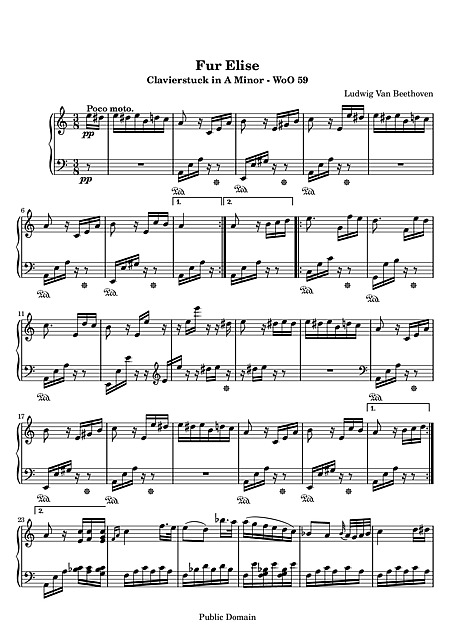
- Composer
- L v Beethoven
- Opus
- WoO 59
- Tonality
- A minor
- Pages
- 4
- Instruments
- Piano
- Type
- Classic
- Licence
- Public domain
- Uploaded by
- Music Library
- Filesize
- 100 KB
Listen

- 4 Year Old Playing Fur Elise Main Theme
- Piano
- Yohan Georgekutty
- Kid just turned 4 plays Fur Elise main theme original version. youtube.com
- Fur Elise
- Piano
- Ivo Pogorelić
- youtube.com
- Für Elise Original version -cantorion
- youtube.com
- Fur Elise - Original version complete
- Piano
- Yohan Georgekutty
- Fur Elise - Beethoven, Original version performed by 4-year-old piano prodigy Yohan Georgekutty. youtube.com
Reviews
Click to rate
About
About Für Elise
Bagatelle No. 25 in A minor for solo piano, commonly known as "Für Elise", is one of Ludwig van Beethoven's most popular compositions. It was not published during his lifetime, only being discovered 40 years after his death, and may be termed either a Bagatelle or an Albumblatt. The identity of "Elise" is unknown; researchers have suggested Therese Malfatti, Elisabeth Röckel, or Elise Barensfeld.
The above text from the Wikipedia article "Für Elise" text is available under CC BY-SA 3.0.
The above text from the Wikipedia article "Für Elise" text is available under CC BY-SA 3.0.
Other arrangements
- ♪HQ
- Simplified
- Piano
- ♪HQ
- Guitar Solo
- Guitar
- ♪
- HQ
- Cello duet
- Cello
- HQ


Free sheet music on other sites
Buy printed editions
We have selected some printed editions we think may be useful.
- Beethoven's Fur Elise for Flute & Piano
- $6.95
- Flute, Piano
- Santorella Publications
- Fur Elise
- $7.95
- Piano Solo, Piano Method
- Music Sales
- Fur Elise
- $3.95
- Piano Solo
- Hal Leonard
- Fur Elise For Classical Guitar
- $3.95
- Classical Guitar, Acoustic Guitar
- Santorella Publications
- Beethoven's Fur Elise for Alto Sax & Piano
- $6.95
- Piano, Alto Saxophone
- Santorella Publications
- Piano Piece in A minor WoO 59 (Fur Elise)
- $6.95
- Harpsichord, Piano Solo
- G. Henle Verlag
- F’_r Elise - The 100 Most Beautiful Classical Original Piano Pieces
- $16.95
- Piano
- Schott Music
- Fur Elise
- $25.00
- Horn, Flute, Clarinet, Bassoon, Oboe
- Trillenium Music Company
More music by Ludwig van Beethoven
- ♪HQ
- ♪
- Piano Sonata No. 14 "Moonlight"
Original version - Piano
- Piano Sonata No. 14 "Moonlight"
- HQ
- Symphony No. 5
Piano reduction - Piano
- Symphony No. 5
- ♪
- Symphony No. 9
Liszt transcription - Piano
- Symphony No. 9
- ♪
- Symphony No. 9
4. Finale (full score) - Orchestra
- Symphony No. 9

Other users also liked
- HQ
- Canon in D
Easy piano - Johann Pachelbel
- Piano
- Canon in D
- ♪HQ
- Happy Birthday Song
Voice, Piano - Mildred J. Hill
- Happy Birthday Song
- ♪
- Prelude and Fugue No. 1
Ave Maria, based on Prelude - Johann Sebastian Bach
- Voice, Piano
- Prelude and Fugue No. 1
- ♪HQ
- Nocturne No. 20
Piano - Frédéric François Chopin
- Nocturne No. 20
- ♪HQ
- The Entertainer
Original version - Scott Joplin
- Piano
- The Entertainer