Orchestral Suite (Overture) No. 3
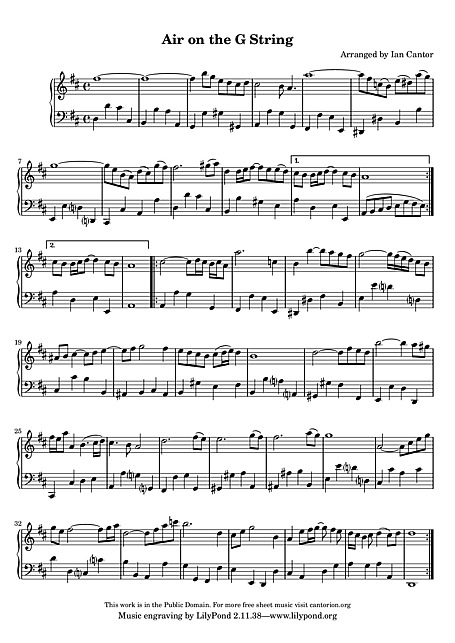
Air on a G string (easy piano)
- Composer
- J S Bach
- Opus
- BWV 1068
- Tonality
- D major
- Pages
- 1
- Arranger
- Ian Cantor
- Instruments
- Piano
- Type
- Simplified classic, Classic, Overture
- Difficulty
- Intermediate
- Licence
- Public domain
- Filesize
- 141 KB
Listen

- Air on a G string
- Violin
- Joel Belov
- Piano
- Robert Gayler
- 1920 recording upload.wikimedia.org
- Air on the G string
- With read-along score. youtube.com
- Air on a G string (easy piano) -cantorion
- youtube.com
Reviews
Click to rate
About
This is an arrangement for piano of Bach's Air, famously known as "Air on a G string". Suitable for grade 3 and over.
"Air on the G String", also known as "Air for G String" and "Celebrated Air", is August Wilhelmj's 1871 arrangement of the second movement of Johann Sebastian Bach's Orchestral Suite No. 3 in D major, BWV 1068.
The above text from the Wikipedia article "Air on the G String" text is available under CC BY-SA 3.0.
"Air on the G String", also known as "Air for G String" and "Celebrated Air", is August Wilhelmj's 1871 arrangement of the second movement of Johann Sebastian Bach's Orchestral Suite No. 3 in D major, BWV 1068.
The above text from the Wikipedia article "Air on the G String" text is available under CC BY-SA 3.0.
About Orchestral Suite (Overture) No. 3
The four orchestral suites, BWV 1066–1069 are four suites by Johann Sebastian Bach. The name ouverture refers only in part to the opening movement in the style of the French overture, in which a majestic opening section in relatively slow dotted-note rhythm in duple meter is followed by a fast fugal section, then rounded off with a short recapitulation of the opening music. More broadly, the term was used in Baroque Germany for a suite of dance-pieces in French Baroque style preceded by such an ouverture. This genre was extremely popular in Germany during Bach's day, and he showed far less interest in it than was usual: Robin Stowell writes that "Telemann's 135 surviving examples [represent] only a fraction of those he is known to have written"; Christoph Graupner left 85; and Johann Friedrich Fasch left almost 100. Bach did write several other ouverture (suites) for solo instruments, notably the Cello Suite no. 5, BWV 1011, which also exists in the autograph Lute Suite in G minor, BWV 995, the Keyboard Partita no. 4 in D, BWV 828, and the Overture in the French style, BWV 831 for keyboard. The two keyboard works are among the few Bach published, and he prepared the lute suite for a "Monsieur Schouster," presumably for a fee, so all three may attest to the form's popularity.
The above text from the Wikipedia article "Orchestral suites (Bach)" text is available under CC BY-SA 3.0.
The above text from the Wikipedia article "Orchestral suites (Bach)" text is available under CC BY-SA 3.0.
Other sub titles
ko:G선상의 아리아, it:L'aria sulla quarta corda, hu:Air a D-dúr szvitből, mk:Напев на Г-жица, ja:G線上のアリア, pt:Ária na corda Sol (G)
Other arrangements
- HQ
- Air on a G string (trombone quartet)
- Trombone Quartet
- ♪HQ
- Air on a G string (string quartet)
- String Quartet, Continuo
- ♪HQ
- 7. Badinerie
- Flute
- ♪HQ
- Air on the G String
- Guitar


Free sheet music on other sites
Buy printed editions
We have selected some printed editions we think may be useful.
- Air from the Orchestral Suite No. 3 in D, BWV 1068
- $5.95
- Schott Music
- Air from Orchestral Suite No. 3
- $3.95
- Piano
- Alfred Publishing
- Air on the G String BWV 1068 (French Horn / Horn)
- $9.95
- French horn, Horn, Piano
- Fentone Music
- Suite No. 3 in D Major
- $11.95
- Orchestra, Full orchestra
- Alfred Publishing
- Six Brandenburg Concertos and Four Orchestral Suites
- $16.95
- Dover Publications
More music by Johann Sebastian Bach
- ♪
- Prelude and Fugue No. 1
Ave Maria, based on Prelude - Voice, Piano
- Prelude and Fugue No. 1
- ♪HQ
- Minuet in G
Original version - Harpsichord, Piano, Clavichord
- Minuet in G
- ♪
- Suite No. 1
Original version - Cello
- Suite No. 1
- ♪HQ
- Prelude and Fugue No. 1
Prelude - Harpsichord, Piano
- Prelude and Fugue No. 1
- ♪
- Goldberg Variations
Complete (scanned) - Piano, Harpsichord
- Goldberg Variations

Other users also liked
- ♪HQ
- Piano Sonata No. 14 "Moonlight"
Piano - Ludwig van Beethoven
- Piano Sonata No. 14 "Moonlight"
- ♪
- Toccata and Fugue
Piano arrangement - Johann Sebastian Bach
- Piano
- Toccata and Fugue
- ♪HQ
- Nocturne No. 20
Piano - Frédéric François Chopin
- Nocturne No. 20
- ♪
- La Campanella
Piano - Franz Liszt
- La Campanella
- ♪HQ
- The Entertainer
Original version - Scott Joplin
- Piano
- The Entertainer