La Campanella
- Composer
- F Liszt
- Opus
- S 141/3
- Cycle
- Grandes Études de Paganini
- Pages
- 15
- Instruments
- Piano
- Type
- Etude
- Difficulty
- Advanced
- Licence
- Public domain
- Uploaded by
- Raul Angulo
- Filesize
- 777 KB
Listen

- Paganini-Liszt La Campanella HQ
- Piano
- Valentina Lisitsa
- Venue
- Seoul
- Live from Seoul. Encore # 1. Liszt "La Campanella" Buy La Campanella video www.amazon.co.uk youtube.com
- La Campanella
- Piano
- Romuald Greiss
- Performed on an 1850 Budynowicz piano upload.wikimedia.org
- La Campanella
- Piano
- Yundi Li
- youtube.com
- Liszt - La Campanella
- Piano
- Evgeny Kissin
- youtube.com
Reviews
Click to rate
About
Una de las piezas más difíciles para piano.
About La Campanella
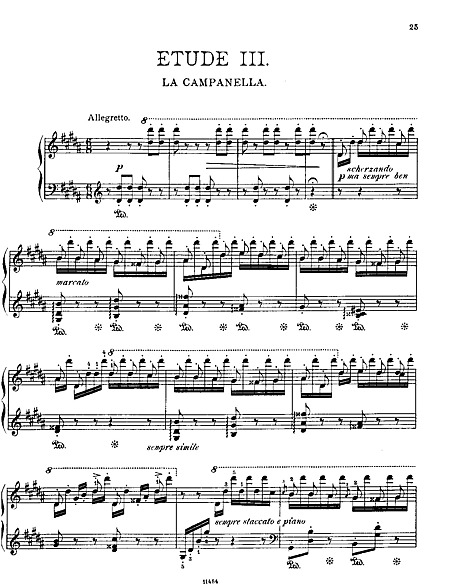
"La campanella" is the nickname given to the third of Franz Liszt's six Grandes études de Paganini, S. 141 (1851). It is in the key of G-sharp minor. This piece is a revision of an earlier version from 1838, the Études d'exécution transcendente d'après Paganini, S. 140. Its melody comes from the final movement of Niccolò Paganini's Violin Concerto No. 2 in B minor, where the tune was reinforced metaphorically by a 'little handbell'. This is illustrated by the large intervals of sixteenth notes in the right hand. Incipit for "La campanella" by Franz Liszt
The above text from the Wikipedia article "La Campanella" text is available under CC BY-SA 3.0.
The above text from the Wikipedia article "La Campanella" text is available under CC BY-SA 3.0.
Free sheet music on other sites
Buy printed editions
We have selected some printed editions we think may be useful.
- La Campanella - No. 3 In 6 Grand Etudes After Paganini
- $3.95
- Piano Solo
- G. Schirmer
More music by Franz Liszt
- ♪
- ♪
- Liebesträume
Liebestraum No. 3 - Piano
- Liebesträume
- HQ
- Salve Regina
SATB a Capella - SATB, Voice
- Salve Regina
- ♪
- Liebesträume
Liebestraum No. 3 - Piano
- Liebesträume
- ♪HQ
Other users also liked
- ♪HQ
- Piano Sonata No. 14 "Moonlight"
- Ludwig van Beethoven
- Piano Sonata No. 14 "Moonlight"
- ♪HQ
- Nocturne No. 20
- Frédéric François Chopin
- Nocturne No. 20
- ♪HQ
- The Entertainer
Original version - Scott Joplin
- Piano
- The Entertainer
- ♪
- Fantaisie-Impromptu
- Frédéric François Chopin
- Fantaisie-Impromptu
- ♪HQ
- Orchestral Suite (Overture) No. 3
Air on a G string (easy piano) - Johann Sebastian Bach
- Piano
- Orchestral Suite (Overture) No. 3