Franz Liszt
177 pieces found
Results 1 - 20
 ♪
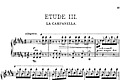
♪- La Campanella
Piano Una de las piezas más difíciles para piano. "La campanella" is the nickname given to the third of Franz Liszt's six Grandes études de Paganini, S. 141 (1851). It is in the key of G-sharp minor. This p...
- Composer
- Franz Liszt
- Opus
- S 141/3
- ♪
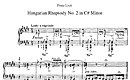
- Hungarian Rhapsody No. 2
Piano Hungarian Rhapsody No. 2 in C-sharp minor, S.244/2, is the second in a set of 19 Hungarian Rhapsodies by composer Franz Liszt, and is by far the most famous of the set.
- Composer
- Franz Liszt
- Opus
- S 244/2
- ♪
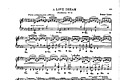
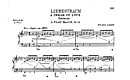
- Liebesträume
Liebestraum No. 3 Publisher: New York: University Society, (ca.1910) Liebesträume is a set of three solo piano works (S.541/R.211) by Franz Liszt, published in 1850. Originally the three Liebesträume were conceived as ...
- Composer
- Franz Liszt
- Instruments
- Piano
- Opus
- S 541
- HQ
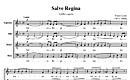
- Salve Regina
SATB a Capella S.66, Salve Regina (1885).
- Composer
- Franz Liszt
- Instruments
- SATB, Voice
- Opus
- S 66
- ♪
- Liebesträume
Liebestraum No. 3 Publisher: New York: University Society, 1917, plate 215-6-CB Liebesträume is a set of three solo piano works (S.541/R.211) by Franz Liszt, published in 1850. Originally the three Liebesträume were co...
- Composer
- Franz Liszt
- Instruments
- Piano
- Opus
- S 541
- ♪HQ
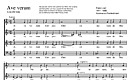
- Ave verum corpus
SATB, Voice S.44, Ave verum corpus (1871).
- Composer
- Franz Liszt
- Opus
- S 44
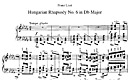
- Hungarian Rhapsody No. 6
Hungarian Rhapsody No. 6 in D-flat major is the sixth work of the 19 Hungarian Rhapsodies composed by Franz Liszt. This work was dedicated to Count Antoine of Appony and uses the form of lassan and fr...
- Composer
- Franz Liszt
- Opus
- S 244/6
- Mephisto Waltz No. 1
Piano The Mephisto Waltzes are four waltzes composed by Franz Liszt from 1859 to 1862, from 1880 to 1881, and in 1883 and 1885. Nos. 1 and 2 were composed for orchestra, and later arranged for piano, piano ...
- Composer
- Franz Liszt
- Opus
- S 514
- HQ
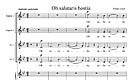
- O salutaris hostia I
- Composer
- Franz Liszt
- Opus
- S 40
- O salutaris hostia I
- HQ
- Ave Maria
SATB 2nd version S.20, Ave Maria I [Second version] (1852).
- Composer
- Franz Liszt
- Instruments
- SATB, Voice
- Opus
- S 20ii
- 6 Grandes Études de Paganini
The Grandes études de Paganini, S. 141, are a series of six études for the piano by Franz Liszt, revised in 1851 from an earlier version. It is almost exclusively in the final version that these piece...
- Composer
- Franz Liszt
- Opus
- S 141
- HQ
- Tantum ergo
2nd Version - Composer
- Franz Liszt
- Instruments
- SSAA, Organ
- Opus
- S 42
- Hungarian Rhapsody No. 1
Hungarian Rhapsody No. 1 in C-sharp minor/E major is the first of a set of 19 Hungarian Rhapsodies by composer Franz Liszt, dedicated to one of his friends and former student, Ede Szerdahelyi. Work on...
- Composer
- Franz Liszt
- Opus
- S 244/1
- O lieb so lang du lieben kannst
- Composer
- Franz Liszt
- Opus
- S 298
- HQ
- Ave Maria II
- Composer
- Franz Liszt
- Opus
- S 38
- ♪
- Liebesträume
Full score Publisher: Leipzig: Fr. Kistner, n.d.(1903), plate K. E. 31 Liebesträume is a set of three solo piano works (S.541/R.211) by Franz Liszt, published in 1850. Originally the three Liebesträume were conc...
- Composer
- Franz Liszt
- Instruments
- Piano
- Opus
- S 541
- 2 Concert Etudes
Waldesrauschen / Gnomenreigen Two Concert Études, S.145, is a set of two piano works composed in Rome around 1862/63 by Franz Liszt and dedicated to Dionys Pruckner, but intended for Sigmund Lebert and Ludwig Stark’s Klavierschule...
- Composer
- Franz Liszt
- Instruments
- Piano
- Opus
- S 145
- Pater noster III
1st Version - Composer
- Franz Liszt
- Instruments
- SATB, Organ
- Opus
- S 41
- HQ
- 6 Consolations
6 Consolations Este conjunto de piezas son 6 llamadas consolaciones donde Franz liszt expresa su parte sencible de una manera muy hermoza
- Composer
- Franz Liszt
- Instruments
- Piano
- Soirées musicales
No. 9 La Danza S.424, Soirées musicales [12 pieces] (1837).
- Composer
- Franz Liszt
- Instruments
- Piano
- Opus
- S 424
- Soirées musicales