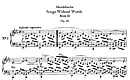
Songs without Words, Book 2
- Composer
- Felix Mendelssohn
- Opus
- Op. 30
- Year composed
- 1833-34
- Instruments
- Piano
Free sheet music
-
- Full book
- Instruments
- Piano
About
Lieder ohne Worte (Songs without Words) is a series of eight books each consisting of six "songs", written for the solo piano by Romantic composer Felix Mendelssohn.
Composition and reception
The eight volumes of Songs without Words were written at various points throughout Mendelssohn's life, two of the volumes being published posthumously. The piano became increasingly popular in Europe during this era, where it became the focal point of many middle-class households. The pieces are within the grasp of pianists of various abilities and this undoubtedly contributed to their popularity. This great popularity has caused many critics to under-rate their musical value.
The first volume was published by Novello in London as Original Melodies for the Pianoforte, but the later volumes used the title Songs without Words.
The works were part of the Romantic tradition of writing short lyrical pieces for the piano, although the specific concept of 'Song without Words' was new. Mendelssohn's sister Fanny wrote a number of similar pieces (though not so entitled) and, according to some music historians, she may have helped inspire the concept. The title "Song without words" seems to have been Felix Mendelssohn's own invention. In 1828, Fanny wrote in a letter My birthday was celebrated very nicely... Felix has given me a 'song without words' for my album (he has lately written several beautiful ones).
Mendelssohn himself resisted attempts to interpret the Songs too literally, and objected when his friend Souchay sought to put words to them to make them literal songs:
Mendelssohn also wrote other Lieder ohne Worte not collected in volumes, published only in the recent years. In 2008 the Italian pianist Roberto Prosseda recorded the most complete collection of Mendelssohn's Lieder ohne Worte for Decca Records including 56 Lieder, some of them never recorded before.
Other composers who were inspired to produce similar sets of pieces of their own included Charles-Valentin Alkan (the five sets of Chants, each ending with a barcarolle), Anton Rubinstein, Ignaz Moscheles and Edvard Grieg (his Lyric Pieces). Both Alkan and Rubinstein frequently included items from the Songs in their recitals. Ferruccio Busoni, who considered Mendelssohn "a master of undisputed greatness" turned to the Songs without Words in the last year of his life for a projected series of recitals in London.
The 8 Volumes
Book 1, Op. 19 (1829-1830)
Song number 2 was written for his sister Fanny to celebrate the birth of her son in 1830.
Book 3, Op. 38 (1836-1837)
Book 3 was dedicated to Rosa von Woringen.
Book 4, Op. 53 (1839-1841)
Book 5, Op. 62 (1842-1844)
Book 5 was dedicated to Clara Schumann.
Book 6, Op. 67 (1843-1845)
Book 6 was dedicated to Sophie Rosen.
Book 7, Op. 85 (1834-1845)
Book 8, Op. 102 (1842-1845)
The scores of the Songs without Words are freely downloadable from IMSLP.
Arrangements
Various arrangements of individual songs have been made: for orchestra, chamber ensemble, or solo instrument with piano accompaniment. One such example is the arrangement of 22 of the songs by Mendelssohn's student, the German violist Friedrich Hermann (1828-1907), for violin and piano.
Media
The above text is available under the Creative Commons Attribution-ShareAlike License ( creativecommons.org/licenses/by-sa/3.0/ ). It uses material from the Wikipedia article "Songs without Words" ( en.wikipedia.org/wiki/Songs_without_Words ).
Composition and reception
The eight volumes of Songs without Words were written at various points throughout Mendelssohn's life, two of the volumes being published posthumously. The piano became increasingly popular in Europe during this era, where it became the focal point of many middle-class households. The pieces are within the grasp of pianists of various abilities and this undoubtedly contributed to their popularity. This great popularity has caused many critics to under-rate their musical value.
The first volume was published by Novello in London as Original Melodies for the Pianoforte, but the later volumes used the title Songs without Words.
The works were part of the Romantic tradition of writing short lyrical pieces for the piano, although the specific concept of 'Song without Words' was new. Mendelssohn's sister Fanny wrote a number of similar pieces (though not so entitled) and, according to some music historians, she may have helped inspire the concept. The title "Song without words" seems to have been Felix Mendelssohn's own invention. In 1828, Fanny wrote in a letter My birthday was celebrated very nicely... Felix has given me a 'song without words' for my album (he has lately written several beautiful ones).
Mendelssohn himself resisted attempts to interpret the Songs too literally, and objected when his friend Souchay sought to put words to them to make them literal songs:
Mendelssohn also wrote other Lieder ohne Worte not collected in volumes, published only in the recent years. In 2008 the Italian pianist Roberto Prosseda recorded the most complete collection of Mendelssohn's Lieder ohne Worte for Decca Records including 56 Lieder, some of them never recorded before.
Other composers who were inspired to produce similar sets of pieces of their own included Charles-Valentin Alkan (the five sets of Chants, each ending with a barcarolle), Anton Rubinstein, Ignaz Moscheles and Edvard Grieg (his Lyric Pieces). Both Alkan and Rubinstein frequently included items from the Songs in their recitals. Ferruccio Busoni, who considered Mendelssohn "a master of undisputed greatness" turned to the Songs without Words in the last year of his life for a projected series of recitals in London.
The 8 Volumes
Book 1, Op. 19 (1829-1830)
- No. 1 Andante con moto in E major
- No. 2 Andante espressivo in A minor
- No. 3 Molto allegro e vivo in A major ("Hunting Song")
- No. 4 Moderato in A major
- No. 5 Poco agitato in F-sharp minor
- No. 6 Andante sostenuto in G minor ("Venezianisches Gondellied" No. 1)
- No. 1 Andante espressivo in E-flat major
- No. 2 Allegro di molto in B-flat minor
- No. 3 Adagio non troppo in E major
- No. 4 Agitato e con fuoco in B minor
- No. 5 Andante grazioso in D major
- No. 6 Allegretto tranquillo in F-sharp minor ("Venezianisches Gondellied" or Venetian Boat Song No. 2)
Song number 2 was written for his sister Fanny to celebrate the birth of her son in 1830.
Book 3, Op. 38 (1836-1837)
- No. 1 Con moto in E-flat major
- No. 2 Allegro non troppo in C minor
- No. 3 Presto e molto vivace in E major
- No. 4 Andante in A major
- No. 5 Agitato in A minor
- No. 6 Andante con moto in A-flat major ("Duetto")
Book 3 was dedicated to Rosa von Woringen.
Book 4, Op. 53 (1839-1841)
- No. 1 Andante con moto in A-flat major
- No. 2 Allegro non troppo in E-flat major
- No. 3 Presto agitato in G minor
- No. 4 Adagio in F major
- No. 5 Allegro con fuoco in A minor ("Volkslied")
- No. 6 Molto Allegro vivace in A major
Book 5, Op. 62 (1842-1844)
- No. 1 Andante espressivo in G major, in 4/4 time. As with many of the Songs without Words, this is in ternary form with a coda. The left hand accompanies the melody throughout with a rhythm of one quaver followed by six semiquavers.
- No. 2 Allegro con fuoco in B-flat major
- No. 3 Andante maestoso in E minor ("Trauermarsch")
- No. 4 Allegro con anima in G major
- No. 5 Andante con moto in A minor ("Venezianisches Gondellied" or Venetian Boat Song No. 3)
- No. 6 Allegretto grazioso in A major ("Frühlingslied" or "Spring Song")
Book 5 was dedicated to Clara Schumann.
Book 6, Op. 67 (1843-1845)
- No. 1 Andante in E-flat major
- No. 2 Allegro leggiero in F-sharp minor
- No. 3 Andante tranquillo in B-flat major
- No. 4 Presto in C major ("Spinnerlied")
- No. 5 Moderato in B minor
- No. 6 Allegro non troppo in E major
Book 6 was dedicated to Sophie Rosen.
Book 7, Op. 85 (1834-1845)
- No. 1 Andante espressivo in F major
- No. 2 Allegro agitato in A minor
- No. 3 Presto in E-flat major
- No. 4 Andante sostenuto in D major
- No. 5 Allegretto in A major
- No. 6 Allegretto con moto in B-flat major
Book 8, Op. 102 (1842-1845)
- No. 1 Andante un poco agitato in E minor
- No. 2 Adagio in D major
- No. 3 Presto in C major
- No. 4 Un poco agitato, ma andante in G minor
- No. 5 Allegro vivace in A major ("Kinderstück")
- No. 6 Andante in C major
The scores of the Songs without Words are freely downloadable from IMSLP.
Arrangements
Various arrangements of individual songs have been made: for orchestra, chamber ensemble, or solo instrument with piano accompaniment. One such example is the arrangement of 22 of the songs by Mendelssohn's student, the German violist Friedrich Hermann (1828-1907), for violin and piano.
Media
The above text is available under the Creative Commons Attribution-ShareAlike License ( creativecommons.org/licenses/by-sa/3.0/ ). It uses material from the Wikipedia article "Songs without Words" ( en.wikipedia.org/wiki/Songs_without_Words ).
Other titles
de:Lieder ohne Worte, fr:Romances sans paroles, ja:無言歌集, ru:Песни без слов, zh:無言歌