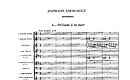
Rapsodie espagnole
- Composer
- Joseph-Maurice Ravel
- Year composed
- 1907
- Instruments
- Piano Four-Hands
Free sheet music
-
- Orchestral score
- Instruments
- Orchestra
- Rating
-
- Original version
- Instruments
- Piano Four-Hands
- Rating
Buy printed editions
We have selected some printed editions we think may be useful.
-
- Rapsodie Espagnole, Mother Goose Suite, and Pavane for a Dead Princess
- Price
- $17.95
- Instruments
- Orchestra, Full orch...
- Publisher
- Dover Publications
About
Rapsodie espagnole is an orchestral rhapsody written by Maurice Ravel. Composed between 1907 and 1908, the Rapsodie represents one of Ravel's first major works for orchestra.
The Rapsodie reflects the profound influence of the Spanish musical heritage that was imparted to Ravel by his Basque mother. As a child, Ravel would listen to his mother sing him folk songs from her country. Later works by Ravel such as Boléro and the opera L'heure espagnole also claim similar sources of inspiration. Ravel composed his Rapsodie only a year before Claude Debussy appeared with his own evocations of Spain in Iberia.
The first version of the Rapsodie was written for two piano 4-hands during the summer of 1907 in a matter of weeks (though one movement, the 'Habanera', had been composed earlier in 1895),; its orchestration took rather longer, being only completed in March 1908. Ravel dedicated the work to Charles Wilfrid de Bériot, professor of piano and composition and son of the renowned Belgian violinist Charles Auguste de Bériot.
The première of the Rapsodie was given by the Orchestre des Concerts Colonne, conducted by Édouard Colonne, at the Chatelet Theatre on March 15, 1908. Although the work attracted only limited popular acclaim, it was highly appreciated by the Spanish composer Manuel de Falla.
The Rapsodie comprises four parts and a performance usually lasts around 15 minutes:
The above text is available under the Creative Commons Attribution-ShareAlike License ( creativecommons.org/licenses/by-sa/3.0/ ). It uses material from the Wikipedia article "Rapsodie espagnole" ( en.wikipedia.org/wiki/Rapsodie_espagnole ).
The Rapsodie reflects the profound influence of the Spanish musical heritage that was imparted to Ravel by his Basque mother. As a child, Ravel would listen to his mother sing him folk songs from her country. Later works by Ravel such as Boléro and the opera L'heure espagnole also claim similar sources of inspiration. Ravel composed his Rapsodie only a year before Claude Debussy appeared with his own evocations of Spain in Iberia.
The first version of the Rapsodie was written for two piano 4-hands during the summer of 1907 in a matter of weeks (though one movement, the 'Habanera', had been composed earlier in 1895),; its orchestration took rather longer, being only completed in March 1908. Ravel dedicated the work to Charles Wilfrid de Bériot, professor of piano and composition and son of the renowned Belgian violinist Charles Auguste de Bériot.
The première of the Rapsodie was given by the Orchestre des Concerts Colonne, conducted by Édouard Colonne, at the Chatelet Theatre on March 15, 1908. Although the work attracted only limited popular acclaim, it was highly appreciated by the Spanish composer Manuel de Falla.
The Rapsodie comprises four parts and a performance usually lasts around 15 minutes:
- Prélude à la nuit: très modéré
- Malagueña: assez vif
- Habanera: assez lent et d'un rythme las
- Feria: assez animé.
The above text is available under the Creative Commons Attribution-ShareAlike License ( creativecommons.org/licenses/by-sa/3.0/ ). It uses material from the Wikipedia article "Rapsodie espagnole" ( en.wikipedia.org/wiki/Rapsodie_espagnole ).
Other titles
Rhapsodie espagnole