La Valse
- Composer
- Joseph-Maurice Ravel
- Year composed
- 1919-20
- Instruments
- Orchestra
Free sheet music
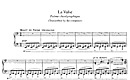
-
- Composer's arrangement for 2 pianos
- Instruments
- Piano, Piano
-
- Composer's solo piano arrangement
- Instruments
- Piano
Buy printed editions
We have selected some printed editions we think may be useful.
-
- La Valse for Two Pianos
- Price
- $12.95
- Instruments
- Piano, Piano duet
- Publisher
- Dover Publications
-
- La Valse
- Price
- $12.95
- Instruments
- Orchestra, Full orch...
- Publisher
- Dover Publications
-
- La Valse (Poeme choreographique pour orchestre)
- Price
- $16.95
- Instruments
- Piano
- Publisher
- Editions Durand
-
- La Valse
- Price
- $49.95
- Publisher
- Editions Durand
About
La Valse, un poème chorégraphique (a choreographic poem), is an orchestral work written by Maurice Ravel from February 1919 until 1920, and premiered in Paris on 12 December 1920. While the work has been described as a tribute to the waltz, it is in fact a less sentimental reflection of post-World War I Europe. The composer George Benjamin, in his analysis of La valse, summarized the ethos of the work as follows:
In his tribute to Ravel after the composer's death in 1937, Paul Landormy described the work as follows:
Creation and Meaning
The idea of La Valse began as Wien (German for "Vienna") as early as 1906, where Ravel intended to orchestrate a piece in tribute to the waltz form and to Johann Strauss. An earlier influence from another composer was the waltz from Emmanuel Chabrier's opera Le roi malgré lui. In Ravel's own compositional output, a precursor to La valse was his 1911 Valses nobles et sentimentales, which contains a motif that Ravel reused in the later work. After his service in the French Army, Ravel returned to his original idea of the symphonic poem Wien. Ravel described his own attraction to waltz rhythm as follows, to Jean Marnold, whilst writing La valse:
Ravel completely reworked his idea of Wien into what became La Valse, which was to have been written under commission from Sergei Diaghilev as a ballet. However, Diaghilev never produced the ballet. In spite of this initial rejection for choreographic performance, the work has remained part of the orchestral repertoire since its premiere. Diaghilev's rejection of the piece created a break in the working relationship with Ravel that was never healed. They never spoke to each other again (the music was used for a 1951 ballet of the same title by George Balanchine, who had made dances for Diaghilev.)
Ravel described La valse with the following preface to the score:
Description
The beginning starts quietly (the mist), with the rumbling of the double basses with the celli and harps subsequently joining. Silently and gradually, instruments play fragmented melodies, gradually building into a subdued tune on bassoons and violas. Eventually, the harps signal the beginning culmination of instruments into the graceful melody. Led by the violins, the orchestra erupts into the work's principal waltz theme.
A series of waltzes follows, each with its own character, alternating loud and soft sequences.
Once more, Ravel breaks the momentum. A macabre sequence begins, gradually building into a disconcerting repetition. The orchestra reaches a danse macabre coda, and the work ends with the final measure as the only one in the score not in waltz-time.
The orchestration is for piccolo, 2 flutes, 2 oboes, English horn, 2 clarinets, bass clarinet, 2 bassoons, contrabassoon, 4 french horns, 3 trumpets, 3 trombones, tuba, timpani, bass drum, snare drum, cymbals, triangle, tambourine, tam-tam, guiro, glockenspiel, strings, and 2 harps. Ravel prepared a separate piano transcription of this work.
Ballet
George Balanchine made a ballet to La Valse on New York City Ballet in 1951.
The above text is available under the Creative Commons Attribution-ShareAlike License ( creativecommons.org/licenses/by-sa/3.0/ ). It uses material from the Wikipedia article "La Valse" ( en.wikipedia.org/wiki/La_Valse ).
In his tribute to Ravel after the composer's death in 1937, Paul Landormy described the work as follows:
Creation and Meaning
The idea of La Valse began as Wien (German for "Vienna") as early as 1906, where Ravel intended to orchestrate a piece in tribute to the waltz form and to Johann Strauss. An earlier influence from another composer was the waltz from Emmanuel Chabrier's opera Le roi malgré lui. In Ravel's own compositional output, a precursor to La valse was his 1911 Valses nobles et sentimentales, which contains a motif that Ravel reused in the later work. After his service in the French Army, Ravel returned to his original idea of the symphonic poem Wien. Ravel described his own attraction to waltz rhythm as follows, to Jean Marnold, whilst writing La valse:
Ravel completely reworked his idea of Wien into what became La Valse, which was to have been written under commission from Sergei Diaghilev as a ballet. However, Diaghilev never produced the ballet. In spite of this initial rejection for choreographic performance, the work has remained part of the orchestral repertoire since its premiere. Diaghilev's rejection of the piece created a break in the working relationship with Ravel that was never healed. They never spoke to each other again (the music was used for a 1951 ballet of the same title by George Balanchine, who had made dances for Diaghilev.)
Ravel described La valse with the following preface to the score:
Description
The beginning starts quietly (the mist), with the rumbling of the double basses with the celli and harps subsequently joining. Silently and gradually, instruments play fragmented melodies, gradually building into a subdued tune on bassoons and violas. Eventually, the harps signal the beginning culmination of instruments into the graceful melody. Led by the violins, the orchestra erupts into the work's principal waltz theme.
A series of waltzes follows, each with its own character, alternating loud and soft sequences.
- The variations by oboe, violins and flutes, mild, slightly timid but nevertheless sweet and elegant.
- The eruption of the heavy brass and timpani begins the next ebullient and pompous melody. The tune is sung by the violins as cymbals crash and the brass blare unashamedly.
- Afterwards, the violas lead a tender tune, accompanied by luxuriant humming in the cellos and clarinets. It disappears and once again returns to the sweet variations and extravagant brass.
- Enter a rather restless episode with dramatic violins, accompanied with precocious (yet seemingly wayward) woodwinds. Castanets and pizzicato add to the character of a rather erratic piece. It ends meekly and clumsily in the bassoons.
- The piece relapses into previous melodies, before a poignant and sweet tune begins in the violins. Glissando is a characteristic feature. The gentle violins are accompanied by ornate, chromatic swayings in the cellos and glissando in the harps. The tune is once again repeated by the woodwinds. As it ends, it begins to unleash some kind of climax, when it is suddenly cut off by a sweet flute.
- The flute plays a rather playful, repetitious melody, accompanied by the glockenspiel and triangle. In between, the violins seem to yearn, whilst the harps play and (bizarrely) the horns trill. Once more, as it nears its conclusion, it tries to build up into a climax, but descends once more into the 'mist' of the beginning.
Once more, Ravel breaks the momentum. A macabre sequence begins, gradually building into a disconcerting repetition. The orchestra reaches a danse macabre coda, and the work ends with the final measure as the only one in the score not in waltz-time.
The orchestration is for piccolo, 2 flutes, 2 oboes, English horn, 2 clarinets, bass clarinet, 2 bassoons, contrabassoon, 4 french horns, 3 trumpets, 3 trombones, tuba, timpani, bass drum, snare drum, cymbals, triangle, tambourine, tam-tam, guiro, glockenspiel, strings, and 2 harps. Ravel prepared a separate piano transcription of this work.
Ballet
George Balanchine made a ballet to La Valse on New York City Ballet in 1951.
The above text is available under the Creative Commons Attribution-ShareAlike License ( creativecommons.org/licenses/by-sa/3.0/ ). It uses material from the Wikipedia article "La Valse" ( en.wikipedia.org/wiki/La_Valse ).
Other titles
La Valse, un poème choréographique, La Valse, choreographic poem