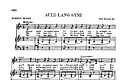
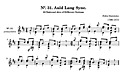
Auld Lang Syne

Free sheet music

  • Music thumbnail♪
    • Rating
    • 5 out of 5
  • Music thumbnailHQ
    • Instruments
    • Classical guitar, Guitar

Buy printed editions

We have selected some printed editions we think may be useful.

About

"Auld Lang Syne" (Scots pronunciation: : note "s" rather than "z") is a Scots poem written by Robert Burns in 1788 and set to the tune of a traditional folk song (Roud # 6294). It is well known in many English-speaking (and other) countries and is often sung to celebrate the start of the New Year at the stroke of midnight. By extension, its use has also become common at funerals, graduations, and as a farewell or ending to other occasions.

The song's Scots title may be translated into English literally as "old long since", or more idiomatically, "long long ago", "days gone by" or "old times". Consequently "For auld lang syne", as it appears in the first line of the chorus, is loosely translated as "for (the sake of) old times".

The phrase "Auld Lang Syne" is also used in similar poems by Robert Ayton (1570–1638), Allan Ramsay (1686–1757), and James Watson (1711) as well as older folk songs predating Burns.Matthew Fitt uses the phrase "In the days of auld lang syne" as the equivalent of "Once upon a time..." in his retelling of fairy tales in the Scots language.

History
Robert Burns sent a copy of the original song to the Scots Musical Museum with the remark, “The following song, an old song, of the olden times, and which has never been in print, nor even in manuscript until I took it down from an old man". Some of the lyrics were indeed "collected" rather than composed by the poet; the ballad "Old Long Syne" printed in 1711 by James Watson shows considerable similarity in the first verse and the chorus to Burns' later poem, and is almost certainly derived from the same "old song". It is a fair supposition to attribute the rest of the poem to Burns himself.

There is some doubt as to whether the melody used today is the same one Burns originally intended, but it is widely used in Scotland and in the rest of the world.

Singing the song on Hogmanay or New Year's Eve very quickly became a Scots custom that soon spread to other parts of the British Isles. As Scots (and other Britons) emigrated around the world, they took the song with them.

Canadian band leader Guy Lombardo is often credited with popularising the use of the song at New Year’s celebrations in America, through his annual broadcasts on radio and television, beginning in 1929. The song became his trademark. In addition to his live broadcasts, Lombardo recorded the song more than once. His first recording was in 1939. A later recording on 29 September 1947 was issued as a single by Decca Records as catalog #24260.

However, earlier newspaper articles describe revellers on both sides of the Atlantic singing the song to usher in the New Year:
  • "Holiday Parties at Lenox" (Massachusetts, USA) (1896) – The company joined hands in the great music room at midnight and sang “Auld Lang Syne” as the last stroke of 12 sounded and the new year came in.
  • "New Year's Eve in London" (London, England) (1910) – Usual Customs Observed by People of All Classes… The passing of the old year was celebrated in London much as usual. The Scottish residents gathered outside of St. Paul's Church and sang “Auld Lang Syne” as the last stroke of 12 sounded from the great bell.
A manuscript of "Auld Lang Syne" is held in the permanent collection of The Lilly Library at Indiana University in Bloomington, Indiana.

Lyrics
The song begins by posing a rhetorical question as to whether it is right that old times be forgotten, and is generally interpreted as a call to remember long-standing friendships.Thomson’s Select Songs of Scotland was published in 1799 in which the second verse about greeting and toasting was moved to its present position at the end.

Most common use of the song involves only the first verse and the chorus. The last lines of both of these are often sung with the extra words "For the sake of" or "And days of", rather than Burns' simpler lines. This allows one note for each word, rather than the slight melisma required to fit Burns' original words to the melody.

The following table of lyrics includes the first few stanzas of the James Watson poem, probably derived from the same folk song as Burns used as the basis for his poem.

† dine = "dinner time"‡ ch = soft throat clearing sound, similar to "lachen" and "Bach" in German* syne = "since" or "then" - pronounced "sign" rather than "zine".

Melody
The tune to which "Auld Lang Syne" is now commonly sung is a pentatonic Scots folk melody, probably originally a sprightly dance in a much quicker tempo.

English composer William Shield seems to quote the "Auld Lang Syne" melody briefly at the end of the overture to his opera Rosina, which may be its first recorded use. The contention that Burns borrowed the melody from Shield is for various reasons highly unlikely, although they may very well both have taken it from a common source, possibly a strathspey called The Miller's Wedding or The Miller's Daughter. The problem is that tunes based on the same set of dance steps necessarily have a similar rhythm, and even a superficial resemblance in melodic shape may cause a very strong apparent similarity in the tune as a whole. For instance, Burns' poem Coming Through the Rye is sung to a tune that might also be based on the Miller's Wedding. The origin of the tune of God Save the Queen presents a very similar problem and for just the same reason, as it is also based on a dance measure. (See the note in the William Shield article on this subject.)

Songwriter George M. Cohan quotes the first line of the "Auld Lang Syne" melody in the second to last line of the chorus of You're a Grand Old Flag. It is plain from the lyrics that this is deliberate.

Uses
At New Year

"Auld Lang Syne" is traditionally sung at the conclusion of a New Year gathering in Scotland and around the world, especially in English speaking countries.

It is common practice that everyone joins hands with the person next to them to form a great circle around the dance floor. At the beginning of the last verse, everyone crosses their arms across their breast, so that the right hand reaches out to the neighbour on the left and vice versa. When the tune ends, everyone rushes to the middle, while still holding hands. When the circle is re-established, everyone turns under the arms to end up facing outwards with hands still joined.

In countries other than Scotland the hands are often crossed from the beginning of the song at variance with Scottish custom. The Scottish practice was demonstrated by the Queen at the Millennium Dome celebrations for the year 2000. The English press berated her for not "properly" crossing her arms, unaware that she was correctly following the Scottish tradition.

Other than New Year

As well as celebrating the New Year, Auld Lang Syne is very widely used to symbolise other "endings/new beginnings" – including farewells, funerals, graduations, the end of a (non-New Year) party or a Boy Scout gathering, the election of a new government, and even the closing of a retail store. The melody is also widely used for other words, especially the songs of sporting and other clubs, and even national anthems. In Scotland and other parts of Britain, in particular, it is associated with celebrations and memorials of Robert Burns. The following list of specific uses is far from comprehensive.

In the English speaking world
  • In Scotland, it is often sung at the end of a céilidh or a dance.
  • In many Burns Clubs, it is sung at the end of the Burns supper.
  • In the United Kingdom, it is played at the close of the annual Congress (conference) of the Trades Union Congress.
  • The song is sung at the end of the Last Night of the Proms by the audience (rather than the performers) and so it is not often listed on the official programme.
  • The song is played at the Passing Out Parade of Young Officers in the Royal Navy as the march up the steps of the Britannia Royal Naval College – to the beat of the slow march, after the tune "Will ye no come back?". This custom is also followed in Naval and Military colleges in many other countries, especially members and former members of the Commonwealth of Nations. Examples include the Royal Military College of Canada, the Royal Military College (Malaysia), the National Defence Academy (India) ( nda.nic.in ), the Indian Military Academy, the Pakistani Military, and at the equivalent colleges in Burma and Nigeria.
  • In the United States, the song is used as a song of remembrance at memorial events. The University of Virginia's alma mater ("The Good Old Song") is also sung to the tune of "Auld Lang Syne".
  • Since 2007, the melody has been used as an introduction to the mass chorus of America the Beautiful that is played by the twelve finalist corps at the Finals Retreat at the Drum Corps International World Championships. Coincidentally, "Auld Lang Syne" and "America the Beautiful" have the same metre, and the lyrics can be sung interchangeably.
In non-English speaking countries
  • In Bangladesh and Bengali parts of India, the melody was the direct inspiration for the popular Bengali song "Purano shei diner kotha" (Memories of the Good Old Days) composed by Nobel laureate Rabindranath Tagore, and forms one of the more recognizable tunes in Rabindra Sangeet (Rabindra's Songs), a body of work of 2,230 songs and lyrical poems that form the backbone of Bengali music.
  • In Chile, the melody is sung in Spanish as a funeral farewell song, specially in the Catholic Church: "Llegó la hora de decir adiós, digamos, al partir, nuestra canción". ("It's time to say goodbye, let's sing, while we leave, this song". In fact, the melody is known as "Canción del adiós" ("Farewell Song").
  • In China students sing the song in Chinese for friendship. The translation would probably be, 'Friendship for ever'. It is also sung at student graduations and funerals. It has the meaning of the ending of relationships. In China it is more of a sad song.
  • In Denmark, the song was translated in 1927 by the famous Danish poet Jeppe Aakjær. Much like Robert Burns' use of dialect, Aakjær translated the song into the Danish dialect sallingbomål, a dialect from the northern part of western Jutland, south of the Limfjord, often hard for other Danes to understand. The song Skuld gammel venskab rejn forgo ("Should auld acquantaince be forgot" — Scots / "Should old acquaintance be forgotten" — English), is an integral part of the Danish Højskole tradition, and often associated with more rural areas and old traditions. Also, the former Danish rock group Gasolin modernised the melody in 1974 with their pop ballad Stakkels Jim ("Poor Jim").
  • In France this song is known as "Ce n'est qu'un au revoir mes frères" ("This is just a goodbye my friends"), and is sung for farewells.
  • In Greece it is very commonly sung translated by the Scouts of Greece. It has the name "Τραγούδι Αποχωρισμού" meaning "Song of Farewell" and it is part of the ending ceremony of scouting Camping trips.
  • In Hungary, this song is often sung by school-leavers at their graduation. The song is translated to Régi, régi dal ("Old, old song").


Japanese version of Auld Lang Syne. This song is called 蛍の光 in Japan ("Hotaru no hikari", meaning "Glow of a firefly"). 1m00s
In Japan, the Japanese students' song Hotaru no hikari ("Glow of a firefly") uses the "Auld Lang Syne" tune. The words describe a series of images of hardships that the industrious student endures in his relentless quest for knowledge, starting with the firefly’s light, which the student uses to keep studying when he has no other light sources. It is commonly heard in graduation ceremonies and at the end of the school day. Many stores and restaurants play it to usher customers out at the end of a business day. The national broadcaster, NHK, also plays this during New Year celebrations.
  • Before the composition of Aegukga, the lyrics of Korea’s national anthem were sung to the tune of this song until composer Ahn Eak-tai composed a new melody to the existing lyrics. Like Japan and Taiwan, it is now used in South Korea as a graduation song and a farewell song to friends or at funerals.
  • Before 1972, it was the tune for the Gaumii salaam anthem of The Maldives (with the current words).
  • In the Netherlands the melody is most known for the Dutch football song Wij houden van Oranje (We love Orange) performed by André Hazes.
  • In Poland the Braterski krąg (Brotherly Circle) song is set to the same tune. It is traditionally sung by the members of the Polish scouting movement as the penultimate song during their meetings. The lyrics, loosely based on the original, are widely known for their last two verses that could be translated as By another campfire on another night we'll see each other again.
  • In Sudan it is translated into Arabic by MR Ahmed Mohammed Saad in (Bakhat ALridha) institute in 1951. And it is commonly used in new year ceremonies or graduation ceremonies.
  • In Thailand, the song Samakkhi Chumnum (Together in unity), which is set to the familiar melody, is sung after sports, and at the end of Boy Scout jamborees as well as for the New Year. The meaning is about the King and national unity. There, it is commonly believed to be a Thai traditional song.
  • In Zimbabwe, the melody is sung in Shona as a funeral farewell song, "Famba zvinyoronyoro, tichasanganiswa muroa ra Jesu", literally, go well, we will be united in the blood of Christ.
Use in films
  • It has been used in a number of films, with its first use in the 1937 Shirley Temple film "Wee Willie Winkie". Shirley sings the song to a Scottish soldier on his death bed.
  • It was also used in the 1942 re-release of the Charlie Chaplin film The Gold Rush with added sound, the song is sung at a New Year's Eve party. It is not certain if the same song was sung when the original silent film was released in 1925.
  • It was sung by submarine crew members celebrating New Years top side in the Blake Edwards Film Operation Petticoat (1959), starring Cary Grant and Tony Curtis.
  • Shirley MacLaine and Fred Mac Murray attend a New Year's Eve celebration near the end of the film "The Apartment". As the clock chimes in the new year, the attendees sing "Auld Lang Syne" when MacLaine's character Fran Kubelik decides to leave her lover.
  • The song has been used in the film Waterloo Bridge—under the name of "The Farewell Waltz"— starring Vivien Leigh and Robert Taylor.
  • It was also used in the Triad Trilogy Infernal Affairs uses the tune in the second film when a triad has finished killing a gang boss.
  • The song is sung in many of the films produced by Frank Capra, including It's a Wonderful Life, Mr. Deeds Goes to Town, and Mr. Smith Goes to Washington.
  • The song is sung in the comedy Elf by Buddy's (Will Ferrell) girlfriend Jovie as Buddy opens gifts with his father and stepmother on Christmas Day.
  • The W.S. Van Dyke film, I Take This Woman (1940), starring Spencer Tracy and Hedy Lamarr uses the song at the film's finale, with the patients and staff of a clinic singing it a cappella; the finale of It's a Wonderful Life is a direct echo of this presentation.
  • In the Samuel Fuller film The Steel Helmet, the film's main character, Sgt. Zack, requests that the song be played by "Fat Paul" on a portable organ. The group of American soldiers is shocked to find out, after a South Korean boy who has accompanied them recognizes and sings Korean lyrics to the tune, that the melody also serves as the South Korean national anthem.
  • In the 1972 Ronald Neame/Irwin Allen film The Poseidon Adventure, the song is sung by the ship's passengers at midnight on New Year's Eve, moments before the ship is struck by a tidal wave and capsized.
  • In The Quiet Earth Zac and Joanne sing it the during an evening celebration after meeting Api, the third person left on Earth.
  • More recently, towards the end of Ghostbusters II, thousands of citizens of New York City sing "Auld Lang Syne", at last united in a moment of peace and love after their collective negativity had long been feeding power to the evil Vigo the Carpathian, weakening the revenant sorcerer enough for the Ghostbusters to defeat him.
  • The song was played in When Harry Met Sally, the New Year's party in which Harry states he never fully understood what the song meant and says "I mean, 'Should old acquaintance be forgot?' Does that mean that we should forget old acquaintances, or does it mean if we happened to forget them, we should remember them, which is not possible because we already forgot?".
  • Sofie Fatale's cell phone ringtone in the film Kill Bill Volume 1 is Auld Lang Syne.
  • In the 2008 film Sex and the City, a recording by Scottish singer Mairi Campbell is used during a montage depicting the characters' actions at New Years. The recording is notable for its use of the original melody as opposed to the commonly performed melody sung today. It is also in contrast to the joyous and jubilant arrangements commonly heard on celebratory occasions, as it consists merely of an acoustic guitar and strings accompanying Campbell's vocals.
  • The American PBS television series Great Performances program titled "Garrison Keillor’s New Year’s Eve Special" had the audience sing an adaptation of the lyrics with a humorous last verse: "I think of all the great, high hearts I had when I was young / And now who are these sad old farts I find myself among?"
  • The music has also been used in game shows, most notably when the sign changed every year on the CBS Match Game and during the credits on the final episode of the original Concentration in 1973.
  • Friz Freleng's 1942 cartoon The Wabbit Who Came to Supper has Bugs Bunny suddenly claim that it is New Year's Day to stop Elmer Fudd from chasing him. Bugs starts singing Auld Lang Syne, only to have Elmer look at a calendar and realize that it is actually July.
  • In the 1987 Bernardo Bertolucci film The Last Emperor, a small Chinese orchestra plays the song on traditional Chinese instruments as the emperor's tutor, Reginald Johnston, boards a ship to leave China and return to England.
  • From Forrest's New Years celebration with Lt. Dan in NYC, the drunk collective singing Auld Lang Syne to welcome in the new year.
  • It is sung by 'Harry' in one of the opening scenes of The Time Traveller's Wife (film)...
  • "Dick Clark's New Years Rockin Eve" uses Auld Lang Syne as its "theme" song. The show has two versions which are both performed by Kyle Warren, Jerry Adamowicz, and Mike Weiland on keyboard, bass, and drums respectively
Some notable performances
  • A somewhat different use of the song as a farewell occurred in October 2000, when it was played as the body of former Canadian Prime Minister Pierre Trudeau left Parliament Hill in Ottawa for the last time, going to Montreal for the state funeral.
  • On the sinking of the Japanese ship Montevideo Maru in World War II, carrying 1,053 Australians (mostly POWs), the Australians in the water sang this for their trapped mates as the ship went down. Surviving Japanese crewman Yosiaki Yamaji reflected on this moment as realising what big hearts the Australian soldiers had.
  • According to the book "Freedom at Midnight"(1975) by Dominique Lapierre and Larry Collins, the song was played to accompany the departure of the final British troops from India through Bombay's "Gateway to India" in 1948, as the British flag over the Gateway was ceremonially lowered for the last time. Similarly it was used at the British hand-over of Hong Kong in 1997.
  • Similarly, again, according to the book "My Vanishing World" (2000) by Nel Adams, the song was sung on 15 January 1949 at the ceremony held as the British were leaving Burma.
  • However, according to the book River of Lost Footsteps by Thant Myint-U, the tune was played as the last British forces boarded the last Royal Navy cruiser on the early morning of 4 January 1948 when Burma gained independence from the United Kingdom.
  • In Pakistan, the tune was played at the formal resignation of President Pervez Musharraf as the country's Chief of Army Staff.
  • On 30 November 2009, students and staff at the University of Glasgow sang the song in 41 different languages simultaneously.

  • Notable Covers and renditions
    • John Philip Sousa included "Auld Lang Syne" in the Trio section of his 1924 march "Ancient and Honorable Artillery Company"
    • Phish has played the song at every new year's concert they have had.
    • Cliff Richard sang the Lord's Prayer to the melody of "Auld Lang Syne" in his Christmas song "The Millennium Prayer".
    • Dan Fogelberg wrote a hit song called "Same Old Lang Syne", included on his 1981 album The Innocent Age. The song was about encountering an old lover, not on New Year's Eve, but on Christmas Eve.
    • Straight No Chaser arranged and performed their rendition of the song "Auld Lang Syne" on their 2008 CD "Holiday Spirits".
    • Canadian band Barenaked Ladies performed a rendition of the song "Auld Lang Syne" on their 2004 CD Barenaked for the Holidays.
    • Billy Joel sang and released "Auld Lang Syne" in his live CD titled 2000 Years: The Millennium Concert, and is known to play the song both lyrically or piano solo in his concerts during holiday seasons.
    • Kenny G recorded a saxophone version of the song in 1999 to commemorate the Millennium. An EP release of the tune contained that version along with long-play and radio-length versions that played under audio snippets from a number of political speeches and news bulletins of the 20th Century.
    • Overboard recorded an a cappella version for their 2008 holiday album, "Tidings".
    • Bobby Darin recorded a Christmas version in 1960, titled "Christmas Auld Lang Syne", while the song "You're a Grand Old Flag" by George M. Cohan, the first line "Should auld acquaintance be forgot" is part of the song's chorus, and is also cited in the song's instrumental introduction.
    • "Dick Clark's New Years Rockin Eve" uses Auld Lang Syne as its "Theme" song. The show has two versions which are both performed by Kyle Warren, Jerry Adamowicz, and Mike Weiland on keyboard, bass, and drums respectively
    • Dougie MacLean's version is among the best known among Scots at home and abroad.
    Coinage

    The above text is available under the Creative Commons Attribution-ShareAlike License ( creativecommons.org/licenses/by-sa/3.0/ ). It uses material from the Wikipedia article "Auld Lang Syne" ( en.wikipedia.org/wiki/Auld_Lang_Syne ).