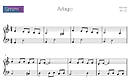
Adagio in G minor

Free sheet music

About

The Adagio in G minor for strings and organ continuo is a neo-baroque composition by Remo Giazotto first published in 1958. It is usually referred to as "Albinoni's Adagio", or "Adagio in G minor by Albinoni, arranged by Giazotto", but it has been established as an entirely original work by Giazotto.

It was supposedly based on a fragment of a second-movement continuo from a "Sonata in G minor" by Tomaso Albinoni purportedly found among the ruins of the old Saxon State Library, Dresden, after it was firebombed by the Allies during World War II, but since Giazotto's death in 1998 it has emerged that no such fragment has been found or recorded to have been in possession by the Saxon State Library, and it is presumed the piece is entirely his own composition.

The piece is most commonly orchestrated for string ensemble and organ, or string ensemble alone, but has achieved a level of fame such that it is commonly transcribed for other instruments.

The Italian conductor Ino Savini transcribed the Adagio for a large orchestra and conducted the piece himself, as in Ostrava in 1967 with the Janacek Philharmonic.(CD "Ino Savini Live collection ISC-029)

The piece has also permeated popular culture, having been used as background music for such films as Gallipoli, television programmes and in advertisements to the point of becoming a cliché for self-consciously "sad" moments.

Uses in popular culture
Film

The Adagio was used:
  • as an underlying score for Orson Welles' film adaption of Kafka's The Trial (1962)
  • as a recurring theme in Rudolf Thome's 1969 film Rote Sonne.
  • in the Werner Herzog film The Enigma of Kaspar Hauser (1974)
  • in the original version of the film Rollerball (1975)
  • in the 1981 Peter Weir film Gallipoli, which was themed around the famous World War I battle of the same name
  • in the 1981 film Dragonslayer.
  • in the animated film Captain Harlock - Arcadia of My Youth from 1982.
  • in the 1983 film Flashdance starring Jennifer Beals and Michael Nouri.
  • in the 1989 Russian animated film Adagio by Garry Bardin
  • in the 1989 Robert Englund version of The Phantom of the Opera, as the Phantom's great masterpiece "Don Juan Triumphant" (with lyrics added)
  • as the ending credits and grave site scene in the 1991 Oliver Stone movie The Doors
  • in the 1998 film Show Me Love by Lukas Moodysson
  • was used by Wong Kar-wai in the 2004 Hong Kong film 2046.
  • quoted by composer Yoshihiro Ike in the 2007 anime, Karas
Television
  • as background music in the '70s sci-fi series Space: 1999 (1975-77)
  • as background music in the BBC comedy/drama series Butterflies (1978-83)
  • as background music on The Sopranos during Gigi Cestone's wake at the funeral home, in the season 3 episode He Is Risen (2001)
  • as background music in the South Korean and Japanese drama Tree of Heaven (2006)
  • as background music in the South Korean drama Beethoven's Virus (2008)
  • In the Malcolm in the Middle episode "Ida's Dance", Malcolm listens to Adagio in G minor and fails the paper he is assigned to write about it.
  • played during the last scene of the last episode of Blackadder the Third
  • as background music during Jason's "monster speech" from season 1, episode 2 of Home Movies I Don't Do Well In Parent-Teacher Conferences (1999)
Popular music

The piece was used in pop music by :
  • Renaissance, in their song "Cold Is Being" on the album Turn of the Cards (1974). Also recorded by frontwoman Annie Haslam as "Save Us All" on her second solo album Still Life (1985)
  • The Doors, in "Feast of Friends" on the album An American Prayer (1978) & as a 40th anniversary bonus track on the album Waiting for the Sun (1968)
  • Yngwie Malmsteen, in Icarus Dream Suite Op. 4 (1984)
  • Above & Beyond as Rollerball, in Albinoni single (2003)
  • DJ Tiesto, in the song "Athena" on the album Parade of the Athletes (2004)
  • Majida El Roumi, in the song Habibi, an Arabic cover of Lara Fabian's Adagio, on the album E'tazalt El Gharam (2006)
  • Sarah Brightman as a vocal version "Anytime, Anywhere" on the album Eden (1998)
  • Sentenced, as an intro in their final concert, Buried Alive (2005)
  • Lara Fabian, as vocal versions both in English and in Italian (lyrics by Lara Fabian), on the album Lara Fabian (2000) The Italian lyric version was later covered by Il Divo on their 2008 album The Promise
  • Sissel Kyrkjebø as a vocal version in English language on her 2006 album The Best: 1986-2006
  • Astrid Bryan, in the song Adagio on the album Taking Over (2009)
  • Miriam Stockley, as a vocal version in Italian (Italian lyric by Alexander Macinante), on the album "Eternal" (2007)
  • Mina, as a vocal version in Italian, (lyrics by Giorgio Calabrese), entitled "Mi parlavi adagio" on the album Sulla tua bocca lo dirò (2009)
  • Louise Tucker and Charlie Skarbek in the song "Graveyard Angel" from the album Midnight Blue (1982)
  • Djivan Gasparyan & Michael Brook - Adagio G Min
  • Ekseption, on their 1970 album Beggar Julia's Time Trip
  • Sweetbox, in Don't Go Away on the album Sweetbox (1998)
  • Typhoon, in Geuraeseo (그래서) on their album Troika(2006)
  • Anthony Wong, in the song Venus (維納斯) on the album Like Water (若水) (2006)
  • Cristian Imparato, in the italian TV talent's contest Io Canto (2010) video
  • Charice Pempengco and Cristian Imparato, in the italian TV talent's contest Io Canto (2010) video

The above text is available under the Creative Commons Attribution-ShareAlike License ( creativecommons.org/licenses/by-sa/3.0/ ). It uses material from the Wikipedia article "Adagio in G minor" ( en.wikipedia.org/wiki/Adagio_in_G_minor ).