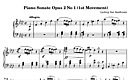
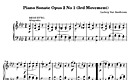
Piano Sonata No. 1
- Composer
- Ludwig van Beethoven
- Opus
- Op. 2/1
- Tonality
- F minor
- Instruments
- Piano
Free sheet music
-

- 1. Allegro
- Instruments
- Piano
-

- 3. Allegretto
- Instruments
- Piano
-

- 4. Prestissimo
- Instruments
- Piano
- Rating
About
Beethoven's Piano Sonata No. 1 in F minor, Op. 2, No. 1, was written in 1795 and dedicated to Joseph Haydn.
A typical performance lasts about 19 minutes.
Structural Analysis
The sonata is in four movements:
The second movement opens with a highly-ornamented lyrical theme in 3/4 time in F major. This is followed by an more agitated transitional passage in D minor accompanied by quiet parallel thirds, followed by a passage full of thirty-second notes in C major. This leads back to a more embellished form of the F major theme, which is followed by an F major variation of the C major section. This Adagio is the earliest composition by Beethoven now in general circulation; it was adapted from the slow movement of a piano quartet from 1785.
The third movement, a minuet in F minor, is conventional in form. It contains two repeated sections, followed by a trio in F major in two repeated sections, after which the first minuet returns. The minuet is characterized by syncopations, dramatic pauses and sharp dynamic contrast. The trio is built around longer, more lyric phrases that pass between the right and left hands in imitative polyphony.
The fourth movement, like the first and third, is in F minor, and is built using a modified sonata form (the development is replaced by new thematic material), but the music was marked as common, not cut, time. The exposition is accompanied by ceaseless eighth-note triplets. The first theme is based on three staccato quarter note chords. A transitional passage leads to a more lyrical but still agitated theme in C minor. The chords of the first theme return to close the exposition. Where the development would be expected to start, there is a completely new theme in A flat, with the first respite from the eighth-note triplets. This is followed by an extended retransition based on alternating motives from the first theme and the "development" theme. The recapitulation presents the first and second themes in F minor. There is no coda, only a fortissimo descending arpeggio—in eighth-note triplets -- to conclude the piece.
The above text is available under the Creative Commons Attribution-ShareAlike License ( creativecommons.org/licenses/by-sa/3.0/ ). It uses material from the Wikipedia article "Piano Sonata No. 1 (Beethoven)" ( en.wikipedia.org/ ... no_Sonata_No._1_(Beethoven) ).
A typical performance lasts about 19 minutes.
Structural Analysis
The sonata is in four movements:
- Allegro in F minor
- Adagio in F major
- Menuetto - Allegretto in F minor
- Prestissimo in F minor
The second movement opens with a highly-ornamented lyrical theme in 3/4 time in F major. This is followed by an more agitated transitional passage in D minor accompanied by quiet parallel thirds, followed by a passage full of thirty-second notes in C major. This leads back to a more embellished form of the F major theme, which is followed by an F major variation of the C major section. This Adagio is the earliest composition by Beethoven now in general circulation; it was adapted from the slow movement of a piano quartet from 1785.
The third movement, a minuet in F minor, is conventional in form. It contains two repeated sections, followed by a trio in F major in two repeated sections, after which the first minuet returns. The minuet is characterized by syncopations, dramatic pauses and sharp dynamic contrast. The trio is built around longer, more lyric phrases that pass between the right and left hands in imitative polyphony.
The fourth movement, like the first and third, is in F minor, and is built using a modified sonata form (the development is replaced by new thematic material), but the music was marked as common, not cut, time. The exposition is accompanied by ceaseless eighth-note triplets. The first theme is based on three staccato quarter note chords. A transitional passage leads to a more lyrical but still agitated theme in C minor. The chords of the first theme return to close the exposition. Where the development would be expected to start, there is a completely new theme in A flat, with the first respite from the eighth-note triplets. This is followed by an extended retransition based on alternating motives from the first theme and the "development" theme. The recapitulation presents the first and second themes in F minor. There is no coda, only a fortissimo descending arpeggio—in eighth-note triplets -- to conclude the piece.
The above text is available under the Creative Commons Attribution-ShareAlike License ( creativecommons.org/licenses/by-sa/3.0/ ). It uses material from the Wikipedia article "Piano Sonata No. 1 (Beethoven)" ( en.wikipedia.org/ ... no_Sonata_No._1_(Beethoven) ).