St Paul (Paulus)
- Composer
- Felix Mendelssohn
- Lyricist
- Pastor Julius Schubring
- Type
- Oratorio
- Opus
- Op. 36
- Instruments
- Voice, SATB, Orchestra
Free sheet music
-

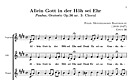
- 3. Allein Gott in der Höh sei Ehr
- Instruments
- Voice, SATB
-

- 9. Dir, Herr, dir will ich mich ergeben
- Instruments
- Voice, SATB
About
Paulus (in English St. Paul) is an oratorio by Felix Mendelssohn Bartholdy. The libretto was begun in 1832 by the composer with Pastor Julius Schubring, a childhood friend, pulling together passages from the New Testament (chiefly the Acts of the Apostles) and Old Testament. It also features chorales or hymn settings after Bach's manner.
The oratorio, which is in two parts, begins with an introduction (#'s 1-3), and continues with the martyrdom of St. Stephen, and St Paul's conversion and baptism (#'s 12-22). Part two continues with the mission of Paul and Barnabas (#'s 23-27), Paul persecution at the hands of his former co-religionists (#'s 28-31), the healing of the lame man of Lystra (#'s 32-36), the resistance of the Jews and heathen (#'s 37-40), Paul's departure from Ephesus (#'s 41-43), and following the mention of his martyrdom, a final chorus based on psalm 103.
Composition of the music began in 1834, and St. Paul was premiered on May 22, 1836 at the Lower Rhenish Music Festival in Düsseldorf. Numerous performances followed in Europe and later in the United States. The English premiere was in Liverpool on 3 October 1836 in a translation by Mendelssohn's friend, Karl Klingermann.
During Mendelssohn's lifetime, St Paul was a popular and frequently performed work. However, compared with such oratorios as Messiah, the Bach Christmas Oratorio and St Matthew Passion or even Mendelssohn's own Elijah it has failed to maintain its place in the choral repertory and is now rarely performed in its entirety.
Instrumentation
Soprano Mezzo-Soprano Tenor Bass Mixed and women's choruses
Strings, Flutes, Oboes, Horns, Trumpet (/Cornet), Trombones Alto/Tenor/Bass, Ophicleide (a successor to the Serpent now usually replaced by a Tuba), Contrabassoon, Timpani and Organ
Movements
Part 1
(English translation of the German from score by Novello, Ewer & Co Ltd Circa 1890.)
(Often two CD set so track / movement displayed)
The above text is available under the Creative Commons Attribution-ShareAlike License ( creativecommons.org/licenses/by-sa/3.0/ ). It uses material from the Wikipedia article "St. Paul (oratorio)" ( en.wikipedia.org/wiki/St._Paul_(oratorio) ).
The oratorio, which is in two parts, begins with an introduction (#'s 1-3), and continues with the martyrdom of St. Stephen, and St Paul's conversion and baptism (#'s 12-22). Part two continues with the mission of Paul and Barnabas (#'s 23-27), Paul persecution at the hands of his former co-religionists (#'s 28-31), the healing of the lame man of Lystra (#'s 32-36), the resistance of the Jews and heathen (#'s 37-40), Paul's departure from Ephesus (#'s 41-43), and following the mention of his martyrdom, a final chorus based on psalm 103.
Composition of the music began in 1834, and St. Paul was premiered on May 22, 1836 at the Lower Rhenish Music Festival in Düsseldorf. Numerous performances followed in Europe and later in the United States. The English premiere was in Liverpool on 3 October 1836 in a translation by Mendelssohn's friend, Karl Klingermann.
During Mendelssohn's lifetime, St Paul was a popular and frequently performed work. However, compared with such oratorios as Messiah, the Bach Christmas Oratorio and St Matthew Passion or even Mendelssohn's own Elijah it has failed to maintain its place in the choral repertory and is now rarely performed in its entirety.
Instrumentation
Soprano Mezzo-Soprano Tenor Bass Mixed and women's choruses
Strings, Flutes, Oboes, Horns, Trumpet (/Cornet), Trombones Alto/Tenor/Bass, Ophicleide (a successor to the Serpent now usually replaced by a Tuba), Contrabassoon, Timpani and Organ
Movements
Part 1
(English translation of the German from score by Novello, Ewer & Co Ltd Circa 1890.)
- Overture
- chorus Herr, der du bist der Gott (Lord! Thou alone art God)
- choral Allein Gott in der Höh' sei Ehr' (To God on high)
- recitative Die Menge der Gläubigen war ein Herz; Wir haben ihn gehört (And the many that Believed)
- chorus Dieser Mensch hört nicht auf zu reden (Now this man ceaseth not)
- recitative & chorus Und sie sahen auf ihn alle (And all that sat in the council)
- aria (S) Jerusalem! die du tötest die Propheten (Jerusalem! Thou that killest the Prophets)
- recitative & chorus Sie aber stürmten auf ihn ein; Steiniget ihn! Er lästert Gott (Then they ran upon him; Stone him to death (He blasphemes God))
- recitative & choral Und sie steinigten ihn; Dir, Herr, dir will ich mich ergeben (And they Stoned him; To thee, O Lord. I yield my spirit)
- recitative Und die Zeugen legten ab ihre Kleider (And the Witnesses)
- chorus Siehe! wir preisen selig, die erduldet (Happy and Blest are they)
- recitative (T) & aria (B) Saulus aber zerstörte die Gemeinde; Vertilge sie, Herr Zebaoth (And Saul made havock of the Church; Consume them all)
- recitative & arioso (Sii) Und zog mit einer Schar; Doch der Herr vergisst der Seinen nicht (But the Lord is mindful of his own)
- recitative & chorus Und als er auf dem Weg war; Saul! was verfolgst du mich? (The Conversion)
- chorus Mache dich auf! Werde Licht! (Rise! Up! Arise.)
- choral Wachet auf! ruft uns die Stimme (Sleepers, wake, a voice is calling)
- recitative Die Männer aber, die seine Gefährten waren (And his companions)
- aria (B) Gott, sei mir gnädig nach deiner Güte (O God, have Mercy)
- recitative Es war aber ein Jünger zu Damaskus (Anth there was a Desciple)
- aria (B) & chorus Ich danke dir, Herr, mein Gott... Der Herr wird die Tränen (I praise thee, O Lord)
- recitative Und Ananias ging hin (And Ananias went his way)
- chorus O welch eine Tiefe des Reichtums der Weisheit (O great is the depth)
(Often two CD set so track / movement displayed)
- 23. chorus Der Erdkreis ist nun des Herrn (The Nations are now the Lord's)
- 24. recitative Und Paulus kam zu der Gemeinde (And Paul came to the congregation)
- 25. duettino (TB) So sind wir nun Botschafter an Christi Statt (Now we are Ambassadors)
- 26. chorus Wie lieblich sind die Boten (How lovely are the Messengers)
- 27. recitative & Arioso Und wie sie ausgesandt von dem heiligen Geist; Lasst uns singen von der Gnade des Herrn (I will sing of thy great mercies)
- 28. recitative & chorus Da aber die Juden das Volk sahen; So spricht der Herr: ich bin der Herr (But when the Jews; Thus saith the Lord; And they laid wait for Paul)
- 29. chorus & choral Ist das nicht, der zu Jerusalem; O Jesu Christe, wahres Licht (Is this he?; O Thou, the True and Only Light)
- 30. recitative Paulus aber und Barnabas sprachen (But Paul and Barnabas spake freely)
- 31. duet (TB) Denn also hat uns der Herr geboten (For so hath the Lord)
- 32. recitative Und es war ein Mann zu Lystra (And there was a man at Lystra)
- 33. chorus Die Götter sind den Menschen gleich geworden (The gods themselves)
- 34. recitative Und nannten Barnabas Jupiter (And they call Barnabas, Jupiter)
- 35. chorus Seid uns gnädig, hohe Götter (O be gracious, Ye Immortals.)
- 36. recitative & chorus Da das die Apostel hörten; Aber unser Gott ist im Himmel (Now when the Apostles; For know ye not?; But our God abideth in Heaven!)
- 37. recitative Da ward das Volk erreget wider sie (Then the Multitude)
- 38. chorus Hier ist des Herren Tempel (This is Jehovah's Temple)
- 39. recitative Und sie alle verfolgten Paulus (And they all persecuted Paul)
- 40. cavatine (T) Sei getreu bis in den Tod (Be though faithful unto death)
- 41. recitative Paulus sandte hin und liess fordern die Ältesten (And Paul sent and called the elders)
- 42. chorus Schone doch deiner selbst; Was machet ihr, dass ihr weinet (Far be it from thy path)
- 43. chorus Sehet, welch eine Liebe hat uns der Vater erzeiget (See what love)
- 44. recitative Und wenn er gleich geopfert wird (And though he be offered)
- 45. chorus Nicht aber ihm allein, sondern allen (Not only unto him)
- Paulus, Gundula Janowitz, Hans Peter Blochwitz, Theo Adam, conducted by Kurt Masur (CD - Philips, December 1986)
The above text is available under the Creative Commons Attribution-ShareAlike License ( creativecommons.org/licenses/by-sa/3.0/ ). It uses material from the Wikipedia article "St. Paul (oratorio)" ( en.wikipedia.org/wiki/St._Paul_(oratorio) ).
Other titles
en:St Paul