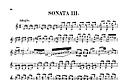
Sonata No. 3

Free sheet music

About

The Sonatas and Partitas for solo violin (BWV 1001–1006) are a set of six works composed by Johann Sebastian Bach. They consist of three sonatas da chiesa, in four movements, and three partitas, in dance-form movements.

The set was completed by 1720, but was only published in 1802 by Nicolaus Simrock in Bonn. Even after publication, it was largely ignored until the celebrated violinist Josef Joachim started performing these works. Today, Bach's Sonatas and Partitas are an essential part of the violin repertoire, and they are frequently performed and recorded.

The Sei Solo – a violino senza Basso accompagnato, as Bach titled them, firmly established the technical capability of the violin as a solo instrument. The pieces often served as an archetype for solo violin pieces for the following generations of composers, including, but not limited to, Eugène Ysaÿe, Béla Bartók, and Paul Hindemith.

History of composition
Bach started composing these works around 1703, while at Weimar, and the set was completed by 1720, when Bach was a Kapellmeister in Köthen. He was almost certainly inspired by Johann Paul von Westhoff's partitas for solo violin, for he worked alongside Westhoff at Weimar, and the older composer's pieces share some stylistic similarities to Bach's. Solo violin repertoire was actively growing at the time: Heinrich Ignaz Biber's celebrated solo passacaglia appeared c.1676, Westhoff's collections of solo violin music were published in 1682 and 1696, Johann Joseph Vilsmayr's Artificiosus Concentus pro Camera in 1715, and finally, Johann Georg Pisendel's solo violin sonata was composed around 1716. The tradition of writing for solo violin did not die after Bach, either; Georg Philipp Telemann published 12 Fantasias for solo violin in 1735.

The tradition of polyphonic violin writing was already well-developed in Germany, particularly by Biber, Johann Heinrich Schmelzer, and the composers of the so-called Dresden school - Johann Jakob Walther and Westhoff. Bach's Weimar and Köthen periods were particularly suitable times for composition of secular music, for he worked as court musician. Bach's cello and orchestral suites date from the Köthen period, as well as the famous Brandenburg concertos and many other well-known collections of instrumental music.

It is not known whether Bach's works were performed during his lifetime, or, if they were, who was the performer. Johann Georg Pisendel and Jean-Baptiste Volumier, both talented violinists in the Dresden court, have been suggested as possible performers, as was Joseph Speiss, leader of the orchestra in Köthen. Friedrich Wilhelm Rust, who would later became part of the Bach family circle in Leipzig, also became a likely candidate. Bach himself also possibly gave the first performance. According to his son Carl Philipp Emanuel Bach, "in his youth, and until the approach of old age, he played the violin cleanly and powerfully".

Manuscripts and major editions
Upon Bach's death in 1750, the original manuscript was passed into the possession, possibly through his second wife Anna Magdalena, of Johann Christoph Friedrich Bach. It was inherited by the last male descendant of J.C.F. Bach, Wilhelm Friedrich Ernst, who passed it onto his sister Louisa of Bückeburg. It was discovered by Georg Pölschau in St. Petersburg, under a pile of old music about to be used as wrapping paper. The manuscript itself was in poor condition, and parts of the d minor Partita had been torn out.

Two other manuscripts were also known to exist. One, identified as an authentic Bach autograph from his Leipzig period, was also acquired by Pölschau from the Royal Library of Berlin. The other, a copy made by one of Bach's students Johann Peter Kellner, was well preserved, despite the fact that the B minor Partita was missing from the set. All three manscripts have been in possession of the Bach-Gesellschaft since 1879, through the efforts of Alfred Dörffel.

Three original editions were also known to have been published. The first edition was printed in 1802 by Nicolaus Simrock of Bonn. It was followed by the 1843 Ferdinand David edition released by Friedrich Kistner of Leipzig, which included Bach's original manuscript on a separate stave below the edited version. Lastly, there was Robert Schumann's 1854 edition, based on David's 1843 edition, but with piano accompaniment, published by Breitkopf and Härtel, also in Leipzig. Another major edition was the 1909 edition of Josef Joachim and Hans Joachim Moser, which was the first edition to be released after entirely based on the original Bach manuscript. Like David, the Joachim-Moser edition also included the unabridged manuscript.

Musical structure
The sonatas each consist of four movements, in the typical slow-fast-slow-fast pattern of the sonata da chiesa. The first two movements are coupled in a form of prelude and fugue. The third (slow) movement is lyrical, while the final movement shares the similar musical structure as a typical binary suite movement. Unlike the sonatas, the partitas are of more unorthodox design. Although still making use of the usual baroque style of allemande, courante, sarabande, and gigue, with some omissions and the addition of galanteries, new elements were introduced into each partita to provide variety.

The Chaconne (Ciaccona) in D minor

The ciaccona (commonly known as Chaconne), the concluding movement of Partita No. 2 in D minor, BWV 1004, surpasses the duration of the previous four movements combined. Along with its disproportional relationship to the rest of the suite, it merits the emphasis given it by musicians and composers alike. The theme, presented in the first four measures in typical chaconne rhythm with a chord progression based on the repeated bass note pattern D D C♯ D B♭ G A D, begets the rest of the movement in a series of variations. The overall form is a triptych, the middle section of which is in major mode. It represents the pinnacle of the solo violin repertoire in that it covers every aspect of violin playing known during Bach's time. It is still one of the most technically and musically demanding pieces for the instrument.

Since Bach's time, several different transcriptions of the piece have been made for other instruments, particularly for the piano (by Ferruccio Busoni) and for the piano left-hand (by Brahms), as well as for the guitar, first transcribed by Argentinian guitarist and composer Antonio Sinopoli. At least three transcriptions have been published for organ solo. An arrangement for full orchestra (1930) was famously recorded by Leopold Stokowski. Recently, a bassoon transcription by Arthur Weisberg was written to highlight the capabilities of his new key systems for the bassoon.

Johannes Brahms, in a letter to Clara Schumann, said about the ciaccona:

Movements
Sonata No. 1 in G minor, BWV 1001
  1. Adagio
  2. Fuga (Allegro)
  3. Siciliana
  4. Presto
Though the key signature of the manuscript suggests D minor, such was a notational convention in the baroque period, and therefore does not necessarily imply that the piece is in the Dorian mode. The second movement, the fugue, would later be reworked for the organ (in the Prelude and Fugue, BWV 539) and the lute (Fugue, BWV 1000), with the latter being two bars longer than the violin version.

Partita No. 1 in B minor, BWV 1002
  1. Allemanda - Double
  2. Corrente - Double (Presto)
  3. Sarabande - Double
  4. Tempo di Borea - Double
This partita substitutes a Bourrée (marked Tempo di Borea) for the gigue, and each movement is followed by variations called double in French.

Sonata No. 2 in A minor, BWV 1003
  1. Grave
  2. Fuga
  3. Andante
  4. Allegro
Partita No. 2 in D minor, BWV 1004
  1. Allemanda
  2. Corrente
  3. Sarabanda
  4. Giga
  5. Ciaccona
In the original manuscript, Bach marked 'Segue la Corrente' at the end of Allemanda. The powerful Ciaconna (chaconne in English) surpasses the length of the other four movements combined. This movement is considered a pinnacle of the solo violin repertoire, in that it remains one of the most technically and musically demanding pieces since Bach's time.

Sonata No. 3 in C major, BWV 1005
  1. Adagio
  2. Fuga
  3. Largo
  4. Allegro assai
The opening movement of the work introduced a peaceful, slow stacking up of notes, a technique once thought to be impossible on bowed instruments. The fugue is the most complex and extensive out of the three, with the subject derived from the chorale Komm, heiliger Geist, Herre Gott; it sounds almost exactly like London Bridge is Falling Down. Bach employed every element imaginable on this fugue, which included a stretto, an inversion, as well as diverse sorts of double counterpoint.

Partita No. 3 in E major, BWV 1006
  1. Preludio
  2. Loure
  3. Gavotte en rondeau
  4. Menuet I
  5. Menuet II
  6. Bourrée
  7. Giga
A transcription for lute was also made by the composer, cataloged as BWV 1006a.

The above text is available under the Creative Commons Attribution-ShareAlike License ( creativecommons.org/licenses/by-sa/3.0/ ). It uses material from the Wikipedia article "Sonatas and partitas for solo violin (Bach)" ( en.wikipedia.org/ ... itas_for_solo_violin_(Bach) ).