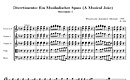
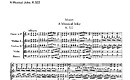
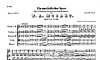
A Musical Joke
- Composer
- Wolfgang Amadeus Mozart
- Opus
- K 522
- Instruments
- Horn, Horn, String Ensemble
Free sheet music
-

- 1. Allegro (full score)
- Instruments
- Orchestra
- Rating
-
Buy printed editions
We have selected some printed editions we think may be useful.
-
- A Musical Joke, K. 522
- Price
- $9.95
- Publisher
- Eulenburg
About
A Musical Joke (in German: Ein Musikalischer Spaß) K. 522, (Divertimento for two horns and single strings) is a composition by Wolfgang Amadeus Mozart; the composer entered it in his Verzeichnis aller meiner Werke ('Catalogue of all my Works') on June 14, 1787. The music is intentionally written to be funny, being liberally sprinkled with obtrusively clumsy, mechanical and over-repetitive composition, together with passages evidently designed to mimic the effects of inaccurate notation and inept performance. Commentators have opined that the piece's purpose is satirical -- that " harmonic and rhythmic gaffes serve to parody the work of incompetent composers" -- though Mozart himself is not known to have revealed his actual intentions.
Structure and Intention
The piece consists of four movements, using forms shared with many other classical divertimenti:
Some theorists believe that A Musical Joke is a parody of works by clumsy composers of Mozart's time. With such an assumption, one would find some points of the score hilarious, such as the more elementary developments of the theme, where the poor composer might feel the agony that he/she had to proceed with the development. Other theorists disagree with that view, saying that perhaps Mozart used parody and comedy as an excuse to try things that at the time were not in practice; the piece would then be intended in a more serious tone than so advertised but only for the composer himself.
The use of asymmetrical phrasing, whole-tone scales, and multitonality is quite foreign to music of the classical era. However, these techniques were later revisited by early 20th century composers like Claude Debussy and Igor Stravinsky, who were searching for a new musical language. In this later context, these conventions were seen as legitimate new techniques in serious music. In Mozart's time, however, these non-classical elements gives the piece its comedy and perfectly expresses the composer's sense of musical humor.
Remarkably, A Musical Joke is the first piece entered in Mozart's list of works following the death of his father Leopold on May 28th.
Issues of Translation
The established English title A Musical Joke is a poor rendering of the German original: as Fritz Spiegl pointed out, 'Spaß' does not strongly connote the jocular -- for which the word 'Scherz' would normally be required. In Spiegl's view, a more accurate translation would have been Some Musical Fun.
Perpetuum mobile: Ein musikalischer Scherz op. 257, a polka by Johann Strauss II is likewise (and more correctly) translated as A Musical Joke.
Other uses
In a modernised version by Waldo de los Rios, the opening of the finale of A Musical Joke was used for many years as the theme tune to the BBC's Horse of the Year Show.
The above text is available under the Creative Commons Attribution-ShareAlike License ( creativecommons.org/licenses/by-sa/3.0/ ). It uses material from the Wikipedia article "A Musical Joke" ( en.wikipedia.org/wiki/A_Musical_Joke ).
Structure and Intention
The piece consists of four movements, using forms shared with many other classical divertimenti:
- Allegro. (In sonata form)
- Menuetto and Trio.
- Adagio cantabile.
- Presto. (Sonata rondo form)
- use of asymmetrical phrasing, or not phrasing by four measure groups, at the beginning of the first movement, which is very uncommon for the classical period,
- use of secondary dominants where subdominant chords are just fair,
- the use of discords in the French horns, satirizing the incompetence of the copyist, or the hornist grabbing the wrong crook,
- use of a whole tone scale in the violinist's high register, probably in order to imitate the player's floundering at the high positions
Some theorists believe that A Musical Joke is a parody of works by clumsy composers of Mozart's time. With such an assumption, one would find some points of the score hilarious, such as the more elementary developments of the theme, where the poor composer might feel the agony that he/she had to proceed with the development. Other theorists disagree with that view, saying that perhaps Mozart used parody and comedy as an excuse to try things that at the time were not in practice; the piece would then be intended in a more serious tone than so advertised but only for the composer himself.
The use of asymmetrical phrasing, whole-tone scales, and multitonality is quite foreign to music of the classical era. However, these techniques were later revisited by early 20th century composers like Claude Debussy and Igor Stravinsky, who were searching for a new musical language. In this later context, these conventions were seen as legitimate new techniques in serious music. In Mozart's time, however, these non-classical elements gives the piece its comedy and perfectly expresses the composer's sense of musical humor.
Remarkably, A Musical Joke is the first piece entered in Mozart's list of works following the death of his father Leopold on May 28th.
Issues of Translation
The established English title A Musical Joke is a poor rendering of the German original: as Fritz Spiegl pointed out, 'Spaß' does not strongly connote the jocular -- for which the word 'Scherz' would normally be required. In Spiegl's view, a more accurate translation would have been Some Musical Fun.
Perpetuum mobile: Ein musikalischer Scherz op. 257, a polka by Johann Strauss II is likewise (and more correctly) translated as A Musical Joke.
Other uses
In a modernised version by Waldo de los Rios, the opening of the finale of A Musical Joke was used for many years as the theme tune to the BBC's Horse of the Year Show.
The above text is available under the Creative Commons Attribution-ShareAlike License ( creativecommons.org/licenses/by-sa/3.0/ ). It uses material from the Wikipedia article "A Musical Joke" ( en.wikipedia.org/wiki/A_Musical_Joke ).
Other titles
Ein Musikalischer Spaß, Divertimento