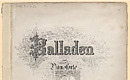
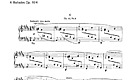
Ballades
- Composer
- Johannes Brahms
- Opus
- Op. 10
- Instruments
- Piano
Free sheet music
-
- 1. Andante
- Instruments
- Piano
-
- 2. Andante
- Instruments
- Piano
-
- 3. Intermezzo: Allegro
- Instruments
- Piano
-
- 4. Andante con moto
- Instruments
- Piano
-
- Complete
- Instruments
- Piano
- Rating
Buy printed editions
We have selected some printed editions we think may be useful.
-
- Ballades, Op. 10
- Price
- $4.50
- Instruments
- Piano
- Publisher
- Alfred Publishing
-
- 4 Ballades, Op. 10
- Price
- $7.95
- Instruments
- Piano
- Publisher
- G. Schirmer
About
The Ballades, Op. 10, constituted some of the finest examples of lyrical piano music written by Johannes Brahms during his youth. They were dated 1854 and dedicated to his friend Julius Otto Grimm. Their composition coincided with the beginning of the composer's lifelong (but chaste) affection for Clara Schumann, the wife of the famous composer who was helping Brahms launch his career.
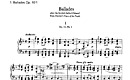
The ballades are arranged in two pairs of two, the members of each pair being in parallel keys. The first ballade was inspired by a Scottish poem "Edward" found in a collection Stimmen der Völker in ihren Liedern compiled by Johann Gottfried Herder. It is also one of the best examples of Brahms's bardic or Ossianic style; its open fifths, octaves, and simple triadic harmonies are supposed to evoke the sense of a mythological past.
The above text is available under the Creative Commons Attribution-ShareAlike License ( creativecommons.org/licenses/by-sa/3.0/ ). It uses material from the Wikipedia article "Ballades, Op. 10 (Brahms)" ( en.wikipedia.org/ ... i/Ballades,_Op._10_(Brahms) ).
The ballades are arranged in two pairs of two, the members of each pair being in parallel keys. The first ballade was inspired by a Scottish poem "Edward" found in a collection Stimmen der Völker in ihren Liedern compiled by Johann Gottfried Herder. It is also one of the best examples of Brahms's bardic or Ossianic style; its open fifths, octaves, and simple triadic harmonies are supposed to evoke the sense of a mythological past.
- No. 1 in D minor. Andante
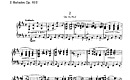
- No. 2 in D major. Andante
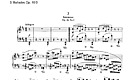
- No. 3 in B minor. Intermezzo. Allegro
- No. 4 in B major. Andante con moto
The above text is available under the Creative Commons Attribution-ShareAlike License ( creativecommons.org/licenses/by-sa/3.0/ ). It uses material from the Wikipedia article "Ballades, Op. 10 (Brahms)" ( en.wikipedia.org/ ... i/Ballades,_Op._10_(Brahms) ).