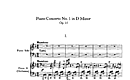
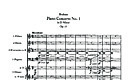
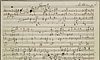
Piano Concerto No. 1
- Composer
- Johannes Brahms
- Type
- Concerto
- Opus
- Op. 15
- Tonality
- D minor
- Year composed
- 1858
- Instruments
- Orchestra, Piano
Free sheet music
-
- Full score
- Instruments
- Orchestra, Piano
-
- Piano Duet
- Instruments
- Piano, Piano
Buy printed editions
We have selected some printed editions we think may be useful.
-
- Piano Concerto No. 1 in D Minor
- Price
- $6.95
- Instruments
- Orchestra, Piano, Ful...
- Publisher
- Dover Publications
About
The Piano Concerto No. 1 in D minor, Op. 15, was composed by Johannes Brahms in 1858. The composer gave its first public performance in Hanover, Germany, the following year.
Form
This concerto is written in the traditional three movements and lasts approximately between 40 and 50 minutes.
Overview
Composition
Brahms worked on the composition for some years, as was the case with many of his works. After a prolonged gestation period, it was first performed on January 22, 1859, in Hanover, Germany, when Brahms was just 25 years old. Five days later, at Leipzig, an unenthusiastic audience hissed at the concerto, while critics savaged it, labelling it "perfectly unorthodox, banal and horrid". In a letter to his close personal friend, the renowned violinist Joseph Joachim, Brahms stated, "I am only experimenting and feeling my way", adding sadly, "all the same, the hissing was rather too much."
Brahms originally conceived the work as a sonata for two pianos. Seeking a grander and fuller sound, Brahms later orchestrated the work in an attempt to transform it into a four-movement symphony. This was, if not his first, one of his first attempts at orchestral writing, and he sought much advice from his friend Julius Otto Grimm. However, he also found that unsatisfactory. Brahms ultimately decided that he had not sufficiently mastered the nuances of orchestral color to sustain a symphony, and instead relied on his skills as a pianist and composer for the piano to complete the work as a concerto. Brahms only retained the original material from the work's first movement; the remaining movements were discarded and two new ones were composed, yielding a work in the more usual three-movement concerto structure.
Biographical points
Brahms' biographers often note that the first sketches for the dramatic opening movement followed quickly on the heels of the 1854 suicide attempt of the composer's dear friend and mentor, Robert Schumann, an event which caused great anguish for Brahms. He finally completed the concerto two years after Schumann's death in 1856, by which time his love for Schumann's widow, Clara Schumann, had fully blossomed.
The degree to which Brahms' personal experience is embedded in the concerto is hard to gauge since several other factors also influenced the musical expression of the piece. The epic mood links the work explicitly to the tradition of the Beethoven symphony that Brahms sought to emulate. The finale of the concerto, for example, is clearly modeled on the last movement of Beethoven's third piano concerto, while the concerto's key of D minor is the same as both Beethoven's Ninth Symphony and Mozart's dramatic Piano Concerto No. 20.
Symphonic and chamber techniques
The work reflects Brahms' effort to combine the piano with the orchestra as equal partners, unlike earlier classical concertos, where the orchestra effectively accompanied the pianist. Even for the young Brahms, the concerto-as-showpiece had little appeal. Instead, he enlisted both orchestra and soloist in the service of the musical ideas; technically difficult passages in the concerto are never gratuitous, but extend and develop the thematic material. Such an approach is thoroughly in keeping with Brahms' artistic temperament, but also reflects the concerto's symphonic origins and ambitions. His effort drew on both chamber music techniques and the pre-classical Baroque concerto grosso, an approach that later was fully realized in Brahms' Second Piano Concerto. This first concerto also demonstrates Brahms' particular interest in scoring for the timpani and the horn, both of whose parts are notoriously difficult, with the timpani playing repeated notes for extended periods of time and the horn part being difficult for its many prominent usages with or without the piano.
Although a work of Brahms' youth, this concerto is a mature work that points forward to his later concertos and his First Symphony. Most notable are its scale and grandeur, as well as the thrilling technical difficulties it presents. As time passed, the work grew in popularity until it was recognized as a masterpiece.
Notable interpretations
The concerto was used as background music to the film The L-Shaped Room, in the recording by Peter Katin.
The above text is available under the Creative Commons Attribution-ShareAlike License ( creativecommons.org/licenses/by-sa/3.0/ ). It uses material from the Wikipedia article "Piano Concerto No. 1 (Brahms)" ( en.wikipedia.org/ ... ano_Concerto_No._1_(Brahms) ).
Form
This concerto is written in the traditional three movements and lasts approximately between 40 and 50 minutes.
- Maestoso (D minor)
- Adagio (D major)
- Rondo: Allegro non troppo (D minor → D major)
Overview
Composition
Brahms worked on the composition for some years, as was the case with many of his works. After a prolonged gestation period, it was first performed on January 22, 1859, in Hanover, Germany, when Brahms was just 25 years old. Five days later, at Leipzig, an unenthusiastic audience hissed at the concerto, while critics savaged it, labelling it "perfectly unorthodox, banal and horrid". In a letter to his close personal friend, the renowned violinist Joseph Joachim, Brahms stated, "I am only experimenting and feeling my way", adding sadly, "all the same, the hissing was rather too much."
Brahms originally conceived the work as a sonata for two pianos. Seeking a grander and fuller sound, Brahms later orchestrated the work in an attempt to transform it into a four-movement symphony. This was, if not his first, one of his first attempts at orchestral writing, and he sought much advice from his friend Julius Otto Grimm. However, he also found that unsatisfactory. Brahms ultimately decided that he had not sufficiently mastered the nuances of orchestral color to sustain a symphony, and instead relied on his skills as a pianist and composer for the piano to complete the work as a concerto. Brahms only retained the original material from the work's first movement; the remaining movements were discarded and two new ones were composed, yielding a work in the more usual three-movement concerto structure.
Biographical points
Brahms' biographers often note that the first sketches for the dramatic opening movement followed quickly on the heels of the 1854 suicide attempt of the composer's dear friend and mentor, Robert Schumann, an event which caused great anguish for Brahms. He finally completed the concerto two years after Schumann's death in 1856, by which time his love for Schumann's widow, Clara Schumann, had fully blossomed.
The degree to which Brahms' personal experience is embedded in the concerto is hard to gauge since several other factors also influenced the musical expression of the piece. The epic mood links the work explicitly to the tradition of the Beethoven symphony that Brahms sought to emulate. The finale of the concerto, for example, is clearly modeled on the last movement of Beethoven's third piano concerto, while the concerto's key of D minor is the same as both Beethoven's Ninth Symphony and Mozart's dramatic Piano Concerto No. 20.
Symphonic and chamber techniques
The work reflects Brahms' effort to combine the piano with the orchestra as equal partners, unlike earlier classical concertos, where the orchestra effectively accompanied the pianist. Even for the young Brahms, the concerto-as-showpiece had little appeal. Instead, he enlisted both orchestra and soloist in the service of the musical ideas; technically difficult passages in the concerto are never gratuitous, but extend and develop the thematic material. Such an approach is thoroughly in keeping with Brahms' artistic temperament, but also reflects the concerto's symphonic origins and ambitions. His effort drew on both chamber music techniques and the pre-classical Baroque concerto grosso, an approach that later was fully realized in Brahms' Second Piano Concerto. This first concerto also demonstrates Brahms' particular interest in scoring for the timpani and the horn, both of whose parts are notoriously difficult, with the timpani playing repeated notes for extended periods of time and the horn part being difficult for its many prominent usages with or without the piano.
Although a work of Brahms' youth, this concerto is a mature work that points forward to his later concertos and his First Symphony. Most notable are its scale and grandeur, as well as the thrilling technical difficulties it presents. As time passed, the work grew in popularity until it was recognized as a masterpiece.
Notable interpretations
- Artur Schnabel with Adrian Boult and BBC Symphony Orchestra
- Claudio Arrau with Bernard Haitink and Royal Concertgebouw Orchestra. Haitink and the Concertgebouw Orchestra have also recorded the concerto two other times, one with Vladimir Ashkenazy and one with Arthur Rubinstein.
- Emil Gilels with Eugen Jochum and the Berlin Philharmonic Orchestra
- Glenn Gould with Leonard Bernstein and the New York Philharmonic, famous for Bernstein's remarks on Gould's "remarkably broad tempi and... frequent departures from Brahms' dynamic indications."
- Glenn Gould with Peter Adler and the Baltimore Symphony Orchestra
- Radu Lupu with Edo de Waart and London Symphony Orchestra
- Leon Fleisher with George Szell and the Cleveland Orchestra
- Krystian Zimerman with Simon Rattle and the Berlin Philharmonic Orchestra
The concerto was used as background music to the film The L-Shaped Room, in the recording by Peter Katin.
The above text is available under the Creative Commons Attribution-ShareAlike License ( creativecommons.org/licenses/by-sa/3.0/ ). It uses material from the Wikipedia article "Piano Concerto No. 1 (Brahms)" ( en.wikipedia.org/ ... ano_Concerto_No._1_(Brahms) ).